Privacy & Censorship in the Digital Age (OCR A-Level CS 1.5.2)
OCR A-Level CS 1.5.2: digital privacy and censorship — how technology erodes privacy, why censoring the internet is hard, and how to argue both sides.

Free Privacy Censorship revision resources (OCR A-Level Computer Science, 1.5.2)
We’ve made exam-style practice for this exact topic, free to download: Privacy Censorship question sheet, mark scheme and cheat sheet. Grab them, have a go, then read the full guide below.
Every search you run, route you drive and post you share leaves a trail. Spec point 1.5.2 includes two of the thorniest issues in computing: privacy and censorship. Like the rest of 1.5.2, these are tested as balanced "discuss" essays, so your job is to understand the tension and argue both sides convincingly.
This post is the last in our Paper 1 series — let's finish strong.
Privacy: what technology threatens
Privacy is a person's right to control information about themselves — who can see it and how it's used. Digital technology makes that control hard to keep, because so much data is collected, often without us noticing:
Search engines and apps log your searches, location, contacts and browsing to build a profile (and to target ads).
Smartphones report location continuously, so your movements can be reconstructed.
ANPR cameras (automatic number-plate recognition) log the plate, time and place of any vehicle in view — building a record of journeys.
Facial recognition can identify you in public spaces from CCTV.
Social media stores far more than you post — likes, who you message, how long you look at things.
None of this is automatically sinister — much of it powers useful, free services. The concern is scale, consent and misuse: data gathered for one purpose can be combined, sold, leaked or used to monitor people.
Censorship: control over what can be seen
Censorship is the restriction or suppression of information — deciding what people are allowed to access or publish. It happens at different levels: governments may block whole sites or topics; platforms remove posts that break their rules; schools and workplaces filter content.
There's a genuine balance here. Censorship can protect people from harm — illegal images, terrorist material, scams, abuse. But it can also be used to suppress dissent, control populations and restrict free speech, and the line between "harmful" and "inconvenient to those in power" is not always clear.
Why censoring the internet is hard
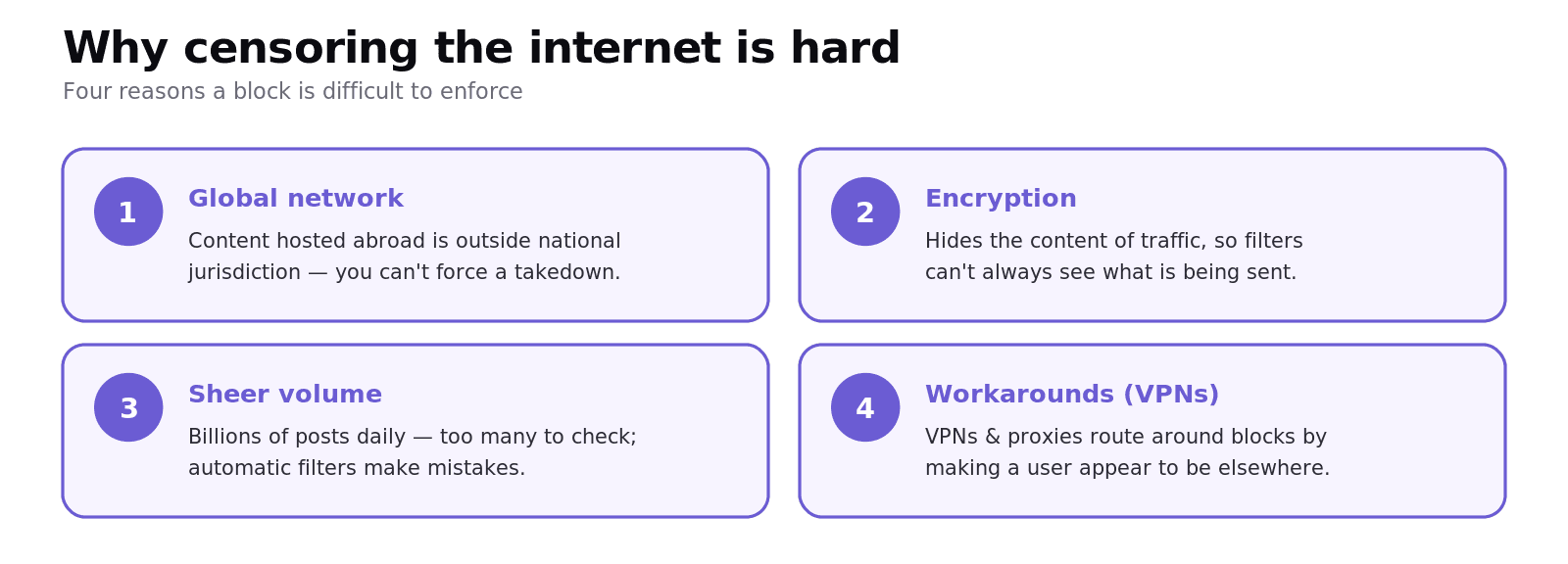
Even where authorities want to block content, the internet's design fights back:
It's global. Content hosted in another country is outside national jurisdiction — you can't easily force a foreign server to take something down.
Encryption hides the content of traffic, so filters can't always see what's being sent.
Sheer volume. Billions of posts and messages appear daily — far too many to check by hand, and automatic filters make mistakes.
Workarounds. VPNs and proxy servers let users route around blocks by appearing to be somewhere else.
These are exactly the "difficulties" a question might ask you to explain — and they apply equally to moderating abusive social media.
Worked example: the ANPR question
"ANPR cameras log the plate, time and place of every vehicle in view. Discuss."
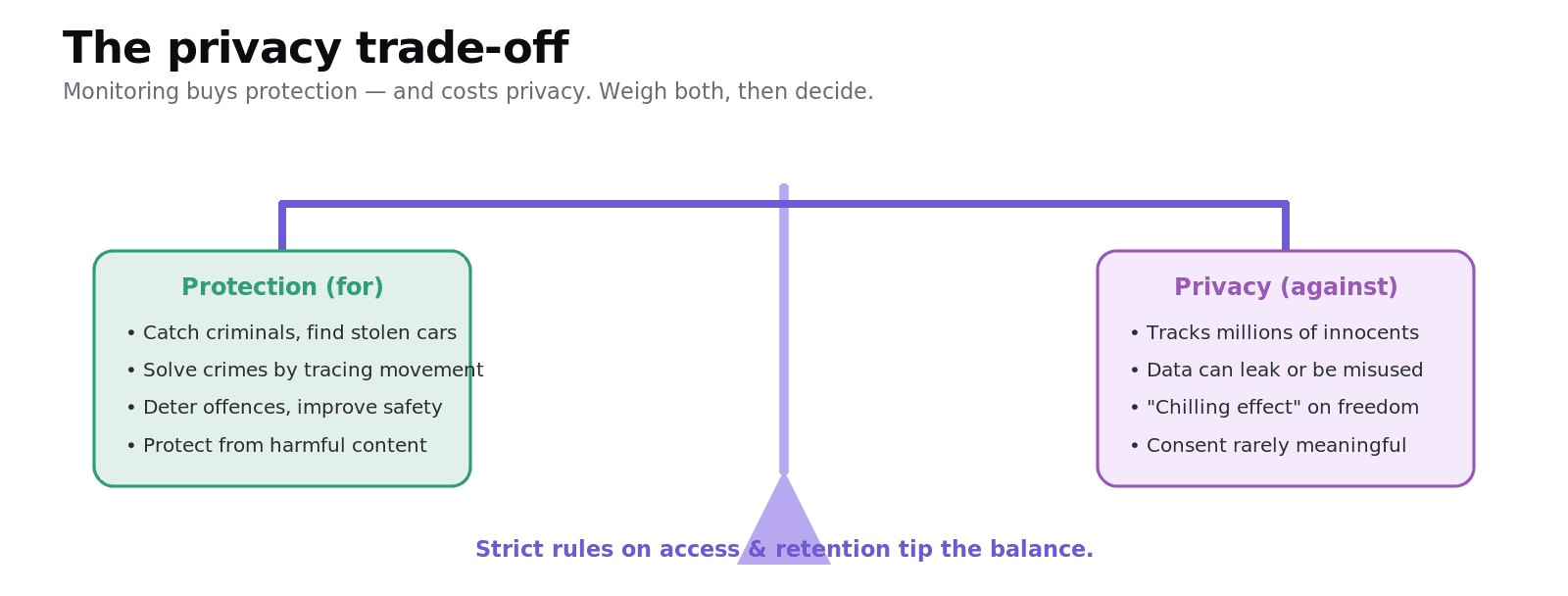
For (the benefit): they help catch criminals, find stolen cars, and solve crimes by tracing movements; they can deter offences and improve road-safety enforcement.
Against (the cost): they record the movements of millions of innocent people; that data could be misused, leaked or used to track individuals; people may feel watched, with a chilling effect on free movement.
Conclusion: ANPR is valuable for policing, but needs strict rules on who can access the data and how long it's kept — security gained must be weighed against the privacy lost.
That for / against / justified-conclusion shape is the same one that works across all of 1.5.2.
Common exam mistakes
Treating privacy and security as opposites with one right answer. Examiners want the trade-off argued, then a justified position.
Vague "it's bad" points. Say what data, collected how, and why that matters.
Forgetting why censorship is hard. Global hosting, encryption, volume and VPNs are concrete, markable points.
One-sided essays. Censorship and surveillance both have real benefits and real harms — give both.
No conclusion. "Discuss" expects you to weigh up and decide.
Quick recap
Privacy = control over your own information; technology erodes it through data collection, tracking, ANPR and facial recognition.
The concern is scale, consent and misuse, not that data is collected at all.
Censorship = restricting what can be seen; it can protect from harm but also suppress free speech.
Censoring the internet is hard because it's global, encrypted, high-volume, and users have VPNs.
Argue both sides and reach a justified conclusion — the security gained weighed against the freedom lost.
Frequently asked questions
What is digital privacy? Digital privacy is a person's right to control information about themselves — who can see it and how it is used — in a world where technology collects large amounts of personal data. Searches, location, browsing history and social media activity can all be gathered, often automatically, which makes keeping that control difficult.
How does technology threaten privacy? Technology threatens privacy through large-scale data collection: search engines and apps log searches, location and browsing; smartphones report location continuously; ANPR cameras record vehicle movements; facial recognition can identify people from CCTV; and social media stores far more than users post. The concern is the scale of collection, lack of consent and potential misuse.
What is censorship? Censorship is the restriction or suppression of information — deciding what people are allowed to access or publish. It can be carried out by governments blocking sites, platforms removing posts, or schools and workplaces filtering content. It can protect people from harmful material but can also be used to suppress free speech.
Why is it difficult to censor the internet? Censoring the internet is difficult because it is global, so content hosted abroad is outside national jurisdiction; encryption hides the content of traffic from filters; the sheer volume of content is too large to check by hand; and users can bypass blocks with VPNs and proxy servers.
What are the arguments for and against surveillance such as ANPR? For: surveillance such as ANPR helps catch criminals, recover stolen vehicles and solve crimes by tracing movements, and can deter offences. Against: it records the movements of millions of innocent people, the data could be misused or leaked, and people may feel constantly watched. A balanced view weighs the security gained against the privacy lost.
How should I structure a privacy or censorship essay? Introduce the issue, give developed arguments for and against, applying them to the scenario, and reach a justified conclusion that weighs security and protection against privacy and freedom. Because these questions are marked with a levels-of-response scheme, a balanced answer with a clear conclusion reaches the higher marks.