Moral, Ethical & Cultural Issues of Computing (OCR A-Level CS 1.5.2)
OCR A-Level CS 1.5.2: the moral, ethical and cultural impact of digital technology — jobs, AI, automated decisions, privacy, the environment and more.

Free Moral Ethical Cultural revision resources (OCR A-Level Computer Science, 1.5.2)
We’ve made exam-style practice for this exact topic, free to download: Moral Ethical Cultural question sheet, mark scheme and cheat sheet. Grab them, have a go, then read the full guide below.
Computing changes the world — and not always for the better. Spec point 1.5.2 covers the moral, ethical and cultural issues raised by digital technology, and it's nearly always tested as a 9- to 12-mark "discuss" essay ("to what extent do you agree…"). You won't be asked to recall a definition so much as to argue both sides and reach a balanced conclusion.
Let's map the issue areas, then learn how to structure that essay so the marks come easily.
Moral vs ethical vs cultural — the framing
It helps to keep three lenses in mind:
Moral issues are about right and wrong for an individual — is it right to download a film for free?
Ethical issues concern professional and societal standards — should a company use an algorithm that might discriminate?
Cultural issues are about the effect on groups and society — how does technology change how communities live, work and communicate?
Most real questions touch all three at once, so you don't need to label them — but the framing reminds you to consider the individual, the profession and society.
The issue areas you should know
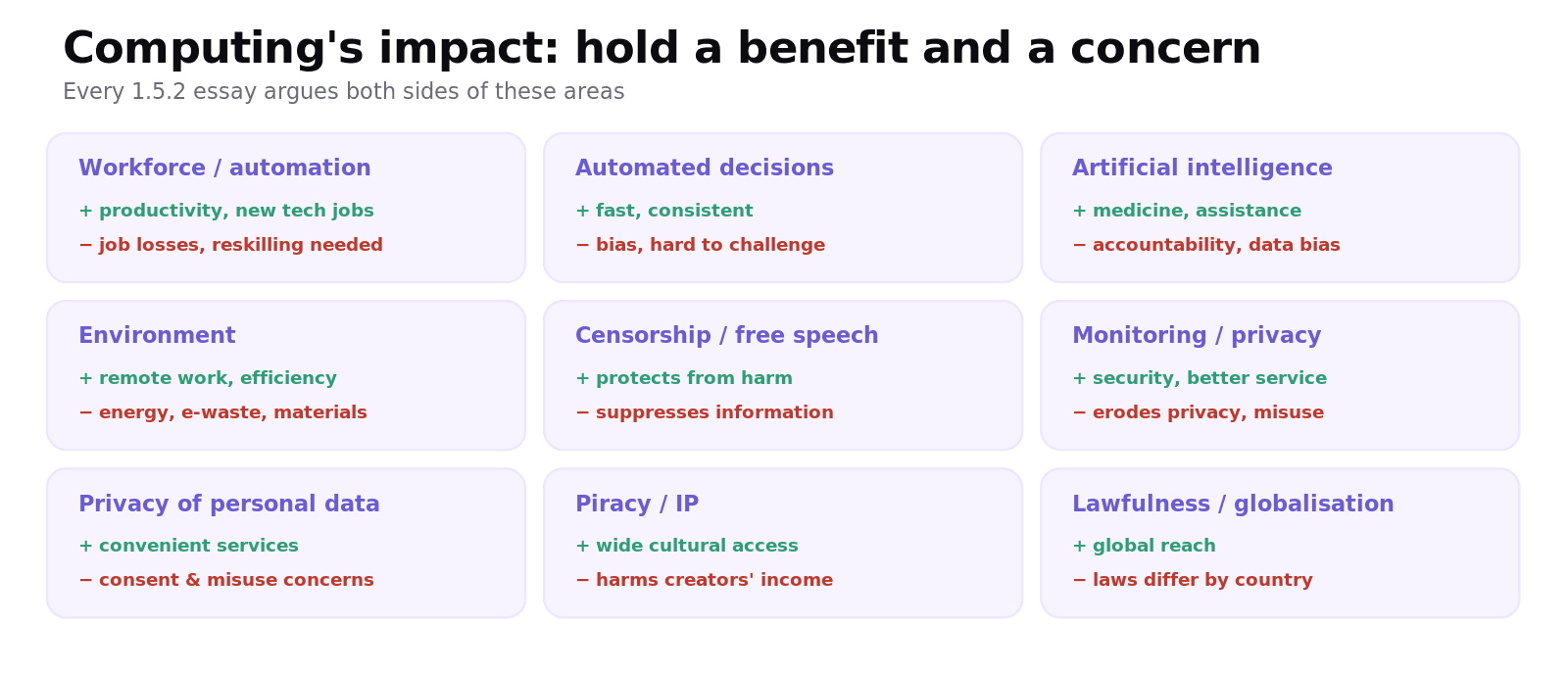
OCR groups the impact of digital technology into recurring themes. For each, hold a benefit and a concern ready:
The workforce — automation and robotics raise productivity but can cause job losses and require reskilling; new tech jobs appear while others disappear.
Automated decision-making — fast and consistent, but can be biased, hard to challenge, and removes the human judgement that catches edge cases.
Artificial intelligence — powerful for medicine, search and assistance, but raises questions of accountability, bias in training data, and what happens as it grows more capable.
The environment — devices and data centres use energy and rare materials, and create e-waste; but computing also enables efficiency, remote work and smarter energy use.
Censorship and freedom of speech — filtering can protect people from harm, but can also be used to suppress information and control populations.
Monitoring and surveillance — improves security and service, but erodes privacy and can be misused.
Privacy of personal information — services are convenient, but companies gather huge amounts of personal data, raising consent and misuse concerns.
Piracy and intellectual property — easy copying harms creators' income, even as digital distribution spreads culture widely.
Lawfulness and globalisation — what's legal varies by country, complicating enforcement online.
How to structure the essay
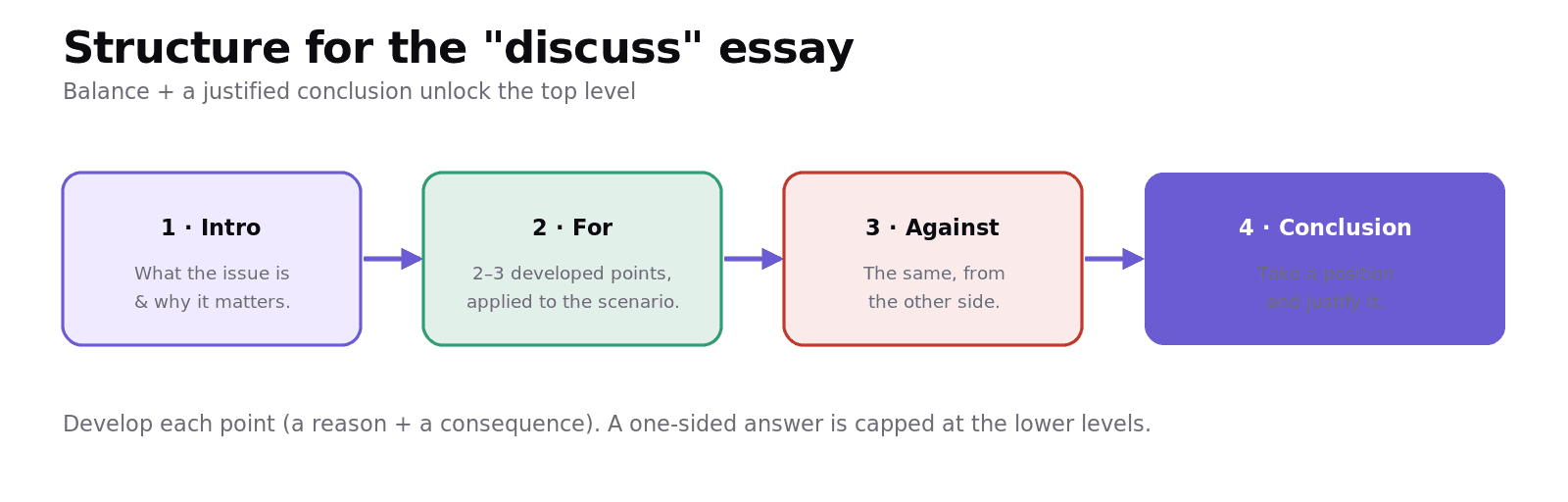
The discuss/evaluate questions are marked with a levels-of-response grid that rewards a balanced answer with a justified conclusion. A reliable structure:
Brief intro — say what the issue is and why it matters.
Arguments for — give two or three points, each developed (a reason and a consequence), and link them to the scenario in the question.
Arguments against — the same, from the other side.
Conclusion — take a position and justify it by weighing the strongest points.
The biggest mark-winner is balance — a one-sided answer is capped at the lower levels. The biggest mark-loser is listing points without developing them or never reaching a conclusion.
Worked example: "AI making decisions about people"
"A bank uses an AI system to decide who gets a loan. Discuss the ethical issues."
For: it's fast and consistent; it can process far more applications; it removes some human bias and tiredness.
Against: the AI may be biased if its training data reflects past discrimination; a rejected applicant can't easily challenge a decision they don't understand; accountability is unclear if it's wrong; it removes human judgement on unusual cases.
Conclusion: AI can help, but for decisions that seriously affect people's lives it should support a human decision-maker, not replace one, with the system audited for bias.
That shape — for, against, justified conclusion — works for any 1.5.2 essay.
Common exam mistakes
Being one-sided. The levels grids cap one-sided answers — always argue both sides.
Listing without developing. Each point needs a reason and a consequence, not just a phrase.
No conclusion. "Discuss / to what extent" expects you to reach and justify a position.
Ignoring the scenario. Apply your points to the specific situation in the question, not in the abstract.
Confusing this with the law. 1.5.2 is about ethics and impact; naming an Act is 1.5.1 — though you can mention a relevant law to strengthen a point.
Quick recap
1.5.2 is about the moral, ethical and cultural impact of computing — usually a 9–12 mark "discuss" essay.
Know the issue areas: workforce/automation, automated decisions, AI, environment, censorship, monitoring, privacy, piracy.
For each, hold a benefit and a concern ready.
Structure: intro → arguments for → arguments against → justified conclusion.
Balance + a justified conclusion unlock the top level; develop each point and apply it to the scenario.
Frequently asked questions
What kinds of issues does OCR's 1.5.2 cover? Spec point 1.5.2 covers the moral, ethical and cultural impact of digital technology, including effects on the workforce and automation, automated decision-making, artificial intelligence, the environment, censorship and free speech, monitoring and surveillance, the privacy of personal data, and piracy of intellectual property.
What is the difference between moral, ethical and cultural issues? Moral issues concern right and wrong for an individual, ethical issues concern professional and societal standards, and cultural issues concern the effect of technology on groups and society. Most real questions touch all three, so it is best to consider the individual, the profession and society together.
How should I answer a 'discuss' question in this topic? Briefly introduce the issue, then give developed arguments for and developed arguments against, applying them to the scenario, and finish with a conclusion that takes a position and justifies it. Balance and a justified conclusion are what unlock the higher mark levels.
Why is automated decision-making an ethical concern? Automated decision-making is fast and consistent, but it can be biased if its data reflects past discrimination, decisions can be hard for affected people to understand or challenge, accountability for errors is unclear, and it removes the human judgement that handles unusual cases. These concerns must be weighed against its efficiency.
How does computing affect the environment? Manufacturing devices uses energy and rare materials, data centres consume large amounts of electricity, and discarded devices create electronic waste. At the same time, computing can reduce environmental impact by enabling remote working, paperless processes and smarter, more efficient use of energy.
Why do these questions reward arguing both sides? The questions are marked with a levels-of-response scheme that rewards a balanced, well-reasoned discussion. A one-sided answer is capped at a lower level because it does not show that you have weighed the competing considerations, which is the skill being assessed, so you should always argue for and against and then justify a conclusion.