Simplifying Boolean Expressions & De Morgan's Laws (OCR A-Level CS 1.4.3)
OCR A-Level CS 1.4.3: the rules of Boolean algebra, De Morgan's laws, and how to simplify Boolean expressions step by step for the exam.

Free Simplifying Boolean De Morgan revision resources (OCR A-Level Computer Science, 1.4.3)
We’ve made exam-style practice for this exact topic, free to download: Simplifying Boolean De Morgan question sheet, mark scheme and cheat sheet. Grab them, have a go, then read the full guide below.
Once you can read a Boolean expression, the next skill is simplifying it — fewer gates means a cheaper, faster circuit. Spec points 1.4.3(a) and (c) cover defining problems with Boolean logic and the rules used to derive and simplify Boolean statements, including De Morgan's laws. "Simplify the expression" is a standard exam question, usually worth 2–5 marks.
Let's collect the rules, learn De Morgan's two laws, and work through simplifications step by step.

The rules of Boolean algebra
These identities are your toolkit. They hold for any Boolean variable, where · is AND, + is OR and a bar (¬) is NOT.
General rules (with 0 and 1, and a variable with itself):
Structural rules:
Commutative: A·B = B·A and A+B = B+A (order doesn't matter).
Associative: A·(B·C) = (A·B)·C and A+(B+C) = (A+B)+C (grouping doesn't matter).
Distributive: A·(B+C) = (A·B)+(A·C) — and the useful reverse, A+(B·C) = (A+B)·(A+C).
Absorption: A + A·B = A and A·(A+B) = A.
De Morgan's laws
The two laws OCR tests most are De Morgan's, which tell you how a NOT distributes over a bracket — you break the bar, and swap the operator:
First law: ¬(A·B) = ¬A + ¬B Second law: ¬(A+B) = ¬A · ¬B
In words: the NOT of an AND becomes the OR of the NOTs, and the NOT of an OR becomes the AND of the NOTs. The memory hook is "break the line, change the sign" — when you split a NOT bar across a bracket, AND becomes OR (and vice versa).
These are invaluable for removing a NOT from over a whole bracket so the rest of the expression can be simplified.
Worked examples
Example 1 — absorption. Simplify A + A·B:
So A + A·B = A — the ·B term is absorbed. (You can confirm with a truth table: the two expressions match for every input.)
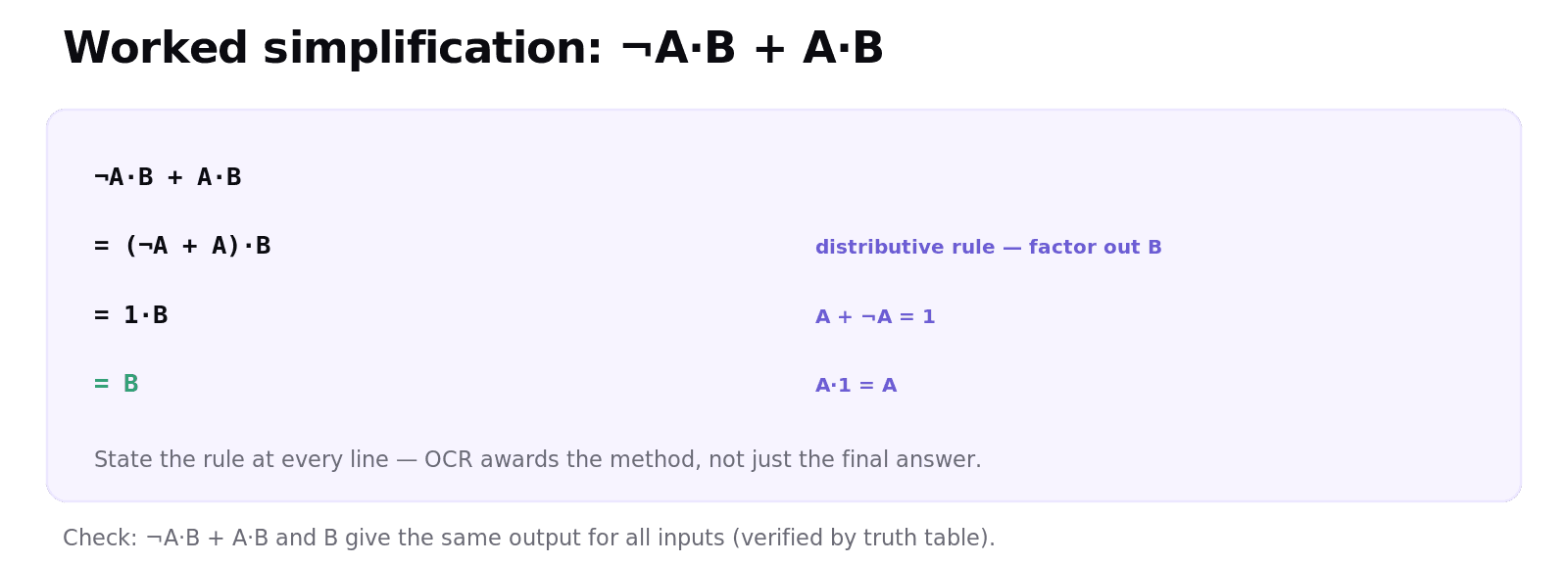
Example 2 — factor with the distributive rule. Simplify ¬A·B + A·B:
Example 3 — De Morgan then simplify. Simplify ¬(A + ¬B):
The trick in every case: apply De Morgan's to clear a NOT off a bracket, then use the general and absorption rules to collapse what's left. Always state the rule you used at each step — OCR awards marks for the working, not just the final answer.
Why simplify?
A simpler expression means fewer logic gates in the physical circuit. That makes the circuit cheaper to build, faster (fewer gates for the signal to pass through), and lower power. Simplifying A + A·B down to just A removes an AND gate and an OR gate entirely.
Common exam mistakes
Getting De Morgan's the wrong way round. ¬(A·B) = ¬A + ¬B (AND under the bar becomes OR). Break the bar and swap the operator.
Forgetting double negation. ¬¬B = B — cancel double bars whenever they appear.
Not stating the rule. Write the rule beside each step (distributive, De Morgan's, absorption…) to earn the method marks.
Misusing A+1. A+1 = 1 (not A); A·0 = 0; A·1 = A; A+0 = A. Mixing these up wrecks a simplification.
Stopping too early (or simplifying wrongly). Check the result against a truth table if unsure — the simplified form must match for every input.
Quick recap
Key rules: A·1=A, A+0=A, A+1=1, A·0=0, A·A=A, A+A=A, A·¬A=0, A+¬A=1, ¬¬A=A.
Absorption: A + A·B = A; A·(A+B) = A. Distributive: A·(B+C) = A·B + A·C.
De Morgan's: ¬(A·B) = ¬A + ¬B and ¬(A+B) = ¬A·¬B — "break the line, change the sign".
Method: use De Morgan's to clear a NOT off a bracket, then collapse with the general/absorption rules.
State the rule at each step; simplifying reduces the number of gates (cheaper, faster circuit).
Frequently asked questions
What are De Morgan's laws? De Morgan's laws describe how a NOT distributes over a bracket. The first law states that ¬(A·B) = ¬A + ¬B, and the second states that ¬(A+B) = ¬A · ¬B. In words, the NOT of an AND becomes the OR of the NOTs, and the NOT of an OR becomes the AND of the NOTs.
How do you apply De Morgan's law? Break the NOT bar that covers the bracket and change the operator inside: an AND becomes an OR and an OR becomes an AND, with the NOT applied to each term. For example, ¬(A + ¬B) becomes ¬A · ¬¬B, which simplifies to ¬A · B using double negation.
Why are Boolean expressions simplified? Simplifying a Boolean expression reduces the number of logic gates needed to build the circuit. This makes the circuit cheaper to manufacture, faster because the signal passes through fewer gates, and lower in power consumption.
What is the absorption rule in Boolean algebra? The absorption rule states that A + A·B = A and A·(A+B) = A. The extra term is absorbed because it adds no new information: whenever A·B is true, A is already true, so the expression depends only on A.
What does the distributive rule do? The distributive rule lets you expand or factor expressions: A·(B+C) = A·B + A·C, and in reverse it lets you factor out a common variable, such as ¬A·B + A·B = (¬A + A)·B. Factoring is often the key step in a simplification.
Why should you state the rule at each step when simplifying? OCR awards method marks for a clear, justified simplification, not only the final answer. Writing the rule used at each line — such as distributive, De Morgan's or absorption — shows your reasoning and secures marks even if a later step contains a slip.