Networks: Characteristics, Protocols & Standards (OCR A-Level CS 1.3.3)
OCR A-Level CS 1.3.3: LANs and WANs, network topologies, what protocols are and why they matter, and the importance of standards. Diagrams and exam tips.

Free Networks Protocols Standards revision resources (OCR A-Level Computer Science, 1.3.3)
We’ve made exam-style practice for this exact topic, free to download: Networks Protocols Standards question sheet, mark scheme and cheat sheet. Grab them, have a go, then read the full guide below.
A network is just computers connected so they can share data and resources — but making that work reliably takes agreed rules. Spec point 1.3.3 covers the characteristics of networks, network topologies, what protocols are, and why standards matter — and "explain what a protocol is and why protocols are important" comes up almost every year.
This guide covers LANs and WANs, topologies, protocols and standards.

What is a network and why use one?
A network is two or more computers connected so they can communicate and share resources. The benefits OCR expects: sharing files and data, sharing hardware (such as a printer), central management and backup, and communication between users. The trade-offs are setup cost, security risks and dependence on the network working.
What is the difference between a LAN and a WAN?
A LAN (Local Area Network) connects devices over a small geographical area, such as one building or site. The organisation owns the cabling/hardware, and data rates are high.
A WAN (Wide Area Network) connects devices (often whole LANs) over a large geographical area, such as between cities or countries. It uses third-party infrastructure (telecom lines, leased connections); the internet is the largest WAN.
What are the main network topologies?
A topology is the layout of how devices are connected. The two OCR focuses on:
Star — every device connects to a central switch. If one cable fails only that device is affected, and performance stays high, but the central switch is a single point of failure and more cabling is needed.
Mesh — devices connect to many others, so there are multiple paths for data. It is very resilient (data reroutes around failures) but expensive to cable; a full mesh connects every node to every other node, while a partial mesh connects only some.
What is a protocol, and why are protocols important?
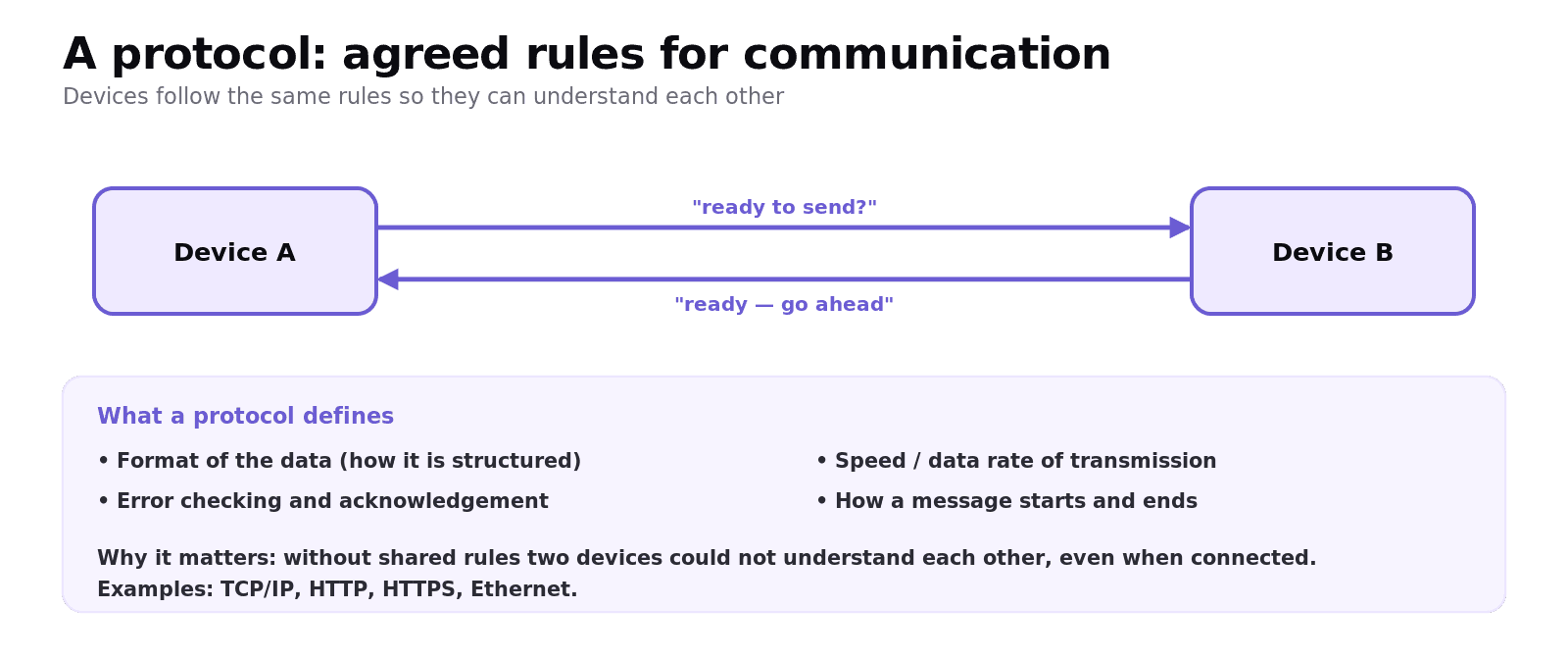
A protocol is a set of rules that governs how data is transmitted between devices — covering things like the format of the data, the speed, error checking, and how the start and end of a message are signalled.
Protocols are important because, without agreed rules, two devices could not understand each other — even if connected. They let hardware and software from different manufacturers communicate, ensure data is sent and received correctly, and make reliable, error-checked transmission possible. Common LAN protocols include TCP/IP, HTTP, HTTPS and Ethernet.
Why do standards matter?
A standard is an agreed, published specification that everyone follows. Standards matter because they ensure interoperability: devices and software from different vendors work together (a printer from one company works with a laptop from another). Without standards, every manufacturer would do things differently and nothing would connect reliably. Protocols are a form of standard.
Common exam mistakes
Defining a protocol as "a connection". A protocol is a set of rules for communication, not the link itself.
Vague "why protocols matter". Say devices could not understand each other without shared rules, and that protocols enable cross-manufacturer communication.
Mixing up LAN and WAN. LAN = small area, organisation owns the hardware; WAN = large area, uses third-party infrastructure.
Confusing topology resilience. Mesh has multiple paths and reroutes around failures; star depends on the central switch.
Forgetting standards = interoperability. That is the key reason they matter.
Quick recap
A network shares data, hardware, backups and communication; costs include security and setup.
LAN = small area, organisation-owned hardware; WAN = large area, third-party infrastructure (the internet is a WAN).
Star topology = central switch (single point of failure); mesh = many paths, very resilient, expensive.
A protocol is a set of rules for transmitting data (format, speed, error checking); protocols let different devices understand each other.
Standards ensure interoperability between equipment from different manufacturers.
Frequently asked questions
What is a computer network? A network is two or more computers connected so they can communicate and share resources, such as files, an internet connection and hardware like printers. Networking also allows central management and backup of data.
What is the difference between a LAN and a WAN? A LAN connects devices over a small area such as one building, with the organisation owning the cabling and hardware. A WAN connects devices or LANs over a large area using third-party infrastructure; the internet is the largest WAN.
What is a network protocol? A protocol is a set of rules that governs how data is transmitted between devices, covering things such as the format, speed, error checking and how messages start and end. Examples include TCP/IP, HTTP and Ethernet.
Why are protocols important? Without agreed rules, two devices could not understand each other even when connected. Protocols allow hardware and software from different manufacturers to communicate and ensure data is transmitted and received correctly and reliably.
What is the difference between star and mesh topologies? In a star topology every device connects to a central switch, so it is fast but the switch is a single point of failure. In a mesh topology devices connect to many others, giving multiple paths and high resilience, but it needs much more cabling.
Why are standards important in networking? Standards ensure interoperability, so equipment and software from different manufacturers work together. Without common standards every vendor would implement things differently and devices would not reliably connect or communicate.