The Internet: TCP/IP Stack, DNS & Packet Switching (OCR A-Level CS 1.3.3)
OCR A-Level CS 1.3.3: the structure of the internet, the four-layer TCP/IP stack, DNS, protocol layering, and packet vs circuit switching. Diagrams and exam tips.

Free Internet TCP IP DNS revision resources (OCR A-Level Computer Science, 1.3.3)
We’ve made exam-style practice for this exact topic, free to download: Internet TCP IP DNS question sheet, mark scheme and cheat sheet. Grab them, have a go, then read the full guide below.
The internet is a worldwide WAN, and OCR wants you to understand the structures that make it work. Spec point 1.3.3 covers the internet's structure, the four-layer TCP/IP stack, DNS, protocol layering, and packet switching — heavily examined, including "name the four layers", "explain the application layer" and "explain packet switching".
This guide covers the TCP/IP stack, DNS, why layering is used, and packet versus circuit switching.
What is the structure of the internet?
The internet is a global network of networks — the largest WAN. Computers are grouped into LANs, which connect to Internet Service Providers (ISPs), which connect to each other to form the worldwide internet. Data travels across it broken into packets (see below), guided by the TCP/IP protocols.
What is the TCP/IP stack?
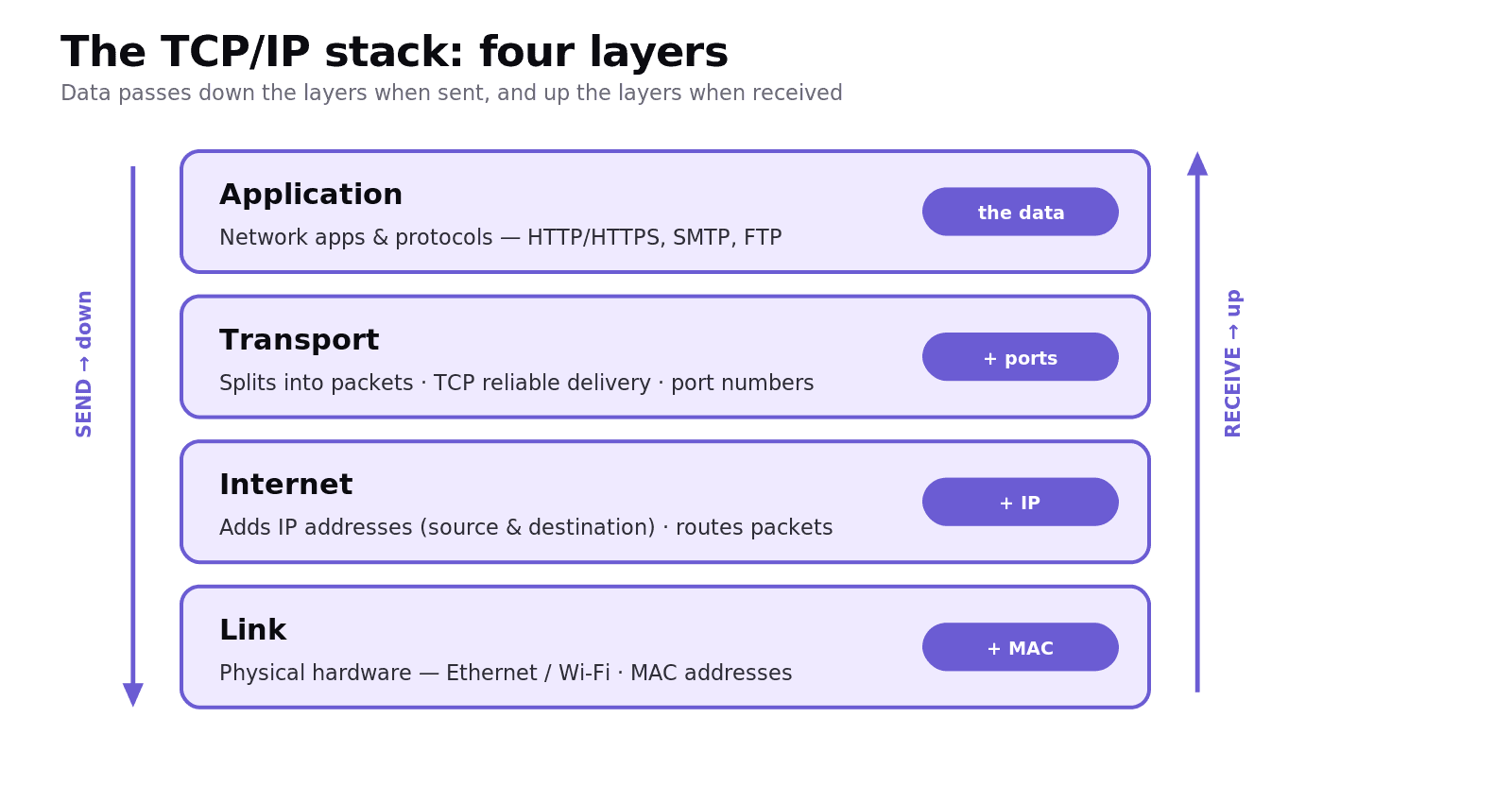
TCP/IP is the set of protocols the internet runs on, organised into four layers, each handling one job. Data passes down the layers as it is sent and up the layers as it is received.
Application layer — where network applications and their protocols operate (HTTP/HTTPS for web, SMTP for email, FTP for files). It produces or reads the actual data the user cares about.
Transport layer — splits the data into packets, numbers them, and uses TCP to manage reliable delivery (and reassembly in order); adds port numbers.
Internet (network) layer — adds IP addresses (source and destination) so each packet can be routed across networks.
Link layer — handles the physical connection: putting packets onto the actual hardware (e.g. Ethernet, Wi-Fi) and adding MAC addresses for the next hop.
What is DNS?

The Domain Name System (DNS) translates human-friendly domain names (like shuttlelearning.com) into the IP addresses computers actually use. When you type a web address, your computer asks a DNS server for the matching IP address, then connects to that server. DNS is like a phone book for the internet — you remember the name, it finds the number.
Why is protocol layering used?
Protocol layering splits networking into independent layers, each with a defined job. The benefits:
Each layer can be developed, changed or replaced independently, as long as the interface to the next layer stays the same (you can switch Wi-Fi for Ethernet at the link layer without touching the others).
It makes the system easier to understand, build and maintain.
Different manufacturers can work on different layers.
What is packet switching?

In packet switching, a message is split into packets, each labelled with its destination, source and a sequence number. Packets travel independently across the network, possibly by different routes, and are reassembled in order at the destination. If a packet is lost it can be resent. This uses the network efficiently because many users share the same links.
By contrast, circuit switching reserves a single dedicated path for the whole communication (like a traditional phone call). It guarantees bandwidth but wastes capacity when idle. The internet uses packet switching.
Common exam mistakes
Getting the TCP/IP layers out of order. Top to bottom when sending: application → transport → internet → link.
Putting jobs in the wrong layer. IP addressing/routing is the internet layer; splitting into packets and reliable delivery is the transport layer; HTTP is the application layer.
Confusing DNS with the IP address. DNS translates a domain name into an IP address; it is not the address itself.
Vague packet switching. Mention packets travelling by different routes and being reassembled in order with sequence numbers.
Forgetting why layering helps. Layers can be changed independently behind a fixed interface.
Quick recap
The internet is the largest WAN: LANs → ISPs → the global network; data moves as packets via TCP/IP.
TCP/IP stack (top to bottom): application (HTTP, etc.), transport (split into packets, TCP reliable delivery, ports), internet (IP addresses, routing), link (physical hardware, MAC).
DNS translates domain names into IP addresses.
Protocol layering: independent layers with fixed interfaces, so each can change without affecting the others.
Packet switching: message split into packets that take different routes and are reassembled; circuit switching reserves a dedicated path.
Frequently asked questions
What are the four layers of the TCP/IP stack? The application layer (network applications and protocols like HTTP), the transport layer (splitting data into packets and reliable delivery with TCP), the internet layer (adding IP addresses and routing) and the link layer (the physical connection and hardware addressing).
What happens at the application layer of the TCP/IP stack? The application layer is where network applications and their protocols operate, such as a web browser using HTTP or HTTPS, email using SMTP, or file transfer using FTP. It produces the data to send or interprets the data received for the user.
What is DNS? The Domain Name System translates human-readable domain names, such as shuttlelearning.com, into the numeric IP addresses computers use to communicate. A computer asks a DNS server for the IP address matching a domain name before connecting.
Why is protocol layering used? Layering divides networking into independent layers, each with a defined job and a fixed interface to the next. This means each layer can be developed, changed or replaced without affecting the others, making the system easier to build and maintain.
What is packet switching? Packet switching splits a message into packets, each labelled with destination, source and a sequence number. The packets travel across the network independently, possibly by different routes, and are reassembled in order at the destination, with lost packets resent.
What is the difference between packet switching and circuit switching? Packet switching splits data into packets that share the network and take different routes, using it efficiently. Circuit switching reserves a single dedicated path for the whole communication, which guarantees bandwidth but wastes capacity when idle. The internet uses packet switching.