Programming Paradigms & Procedural Languages (OCR A-Level CS 1.2.4)
OCR A-Level CS 1.2.4: why different programming paradigms exist, their characteristics, and what makes a language procedural. Worked example and exam tips.

Free Paradigms Procedural revision resources (OCR A-Level Computer Science, 1.2.4)
We’ve made exam-style practice for this exact topic, free to download: Paradigms Procedural question sheet, mark scheme and cheat sheet. Grab them, have a go, then read the full guide below.
Why do thousands of programming languages exist when they all end up as machine code? Because different problems suit different styles of thinking. Spec point 1.2.4 covers the need for and characteristics of programming paradigms, starting with the procedural paradigm — the style most students learn first.
This guide explains what a paradigm is, why we have several, and what makes a language procedural.
What is a programming paradigm and why are there several?
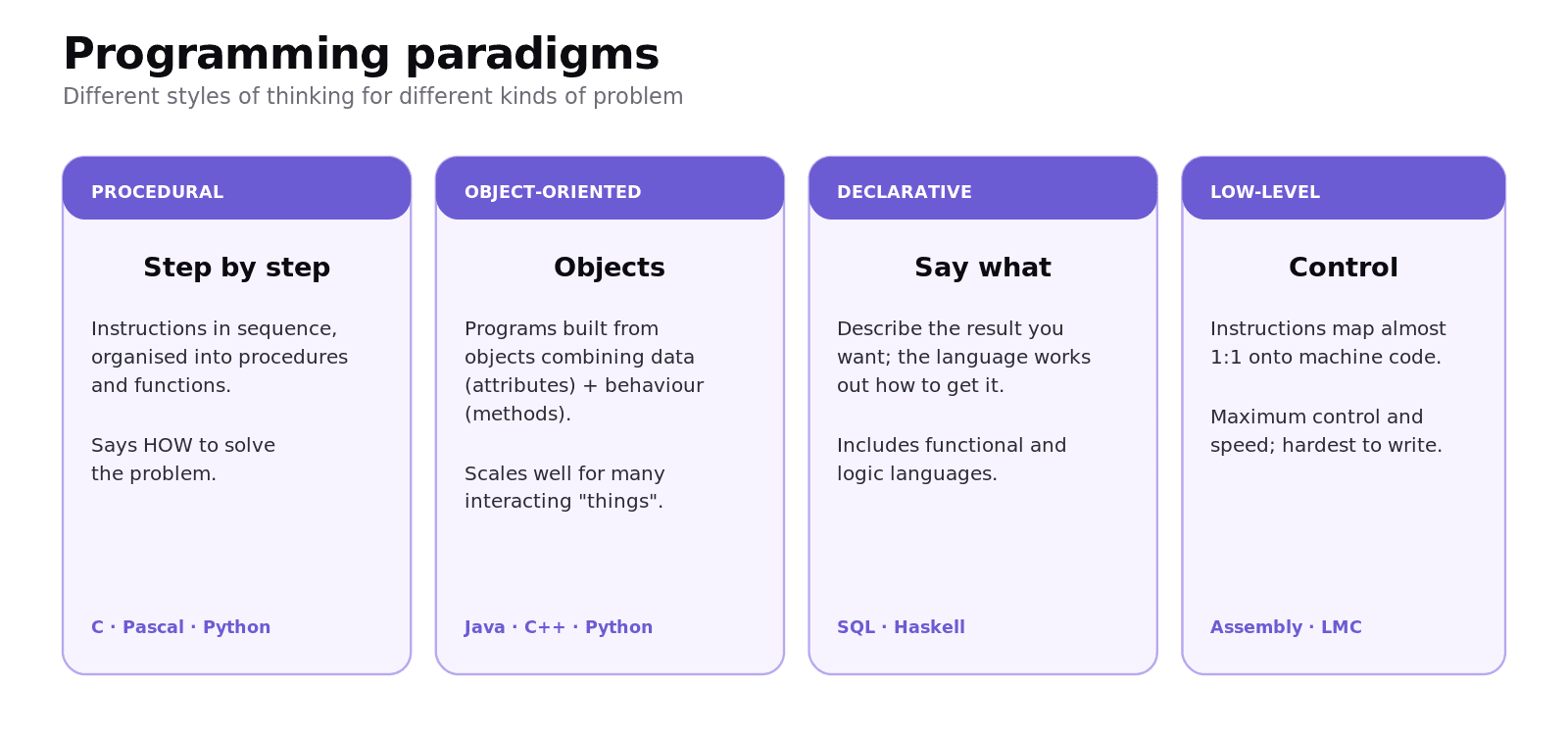
A programming paradigm is a style or approach to programming — a way of structuring and thinking about code. No single style suits every problem, so paradigms exist because different kinds of problem are solved most naturally in different ways, and languages at different levels of abstraction trade ease of writing against control over the hardware.
The paradigms you should recognise:
Procedural — the program is a sequence of instructions organised into procedures and functions, telling the computer step by step how to solve the problem.
Object-oriented — the program is built from objects that combine data and behaviour (covered in its own post).
Declarative (including functional and logic languages such as SQL or Haskell) — you describe what you want, not how to compute it.
Low-level / assembly — instructions that map almost directly onto the processor's machine code, for maximum control.
What are the characteristics of procedural languages?
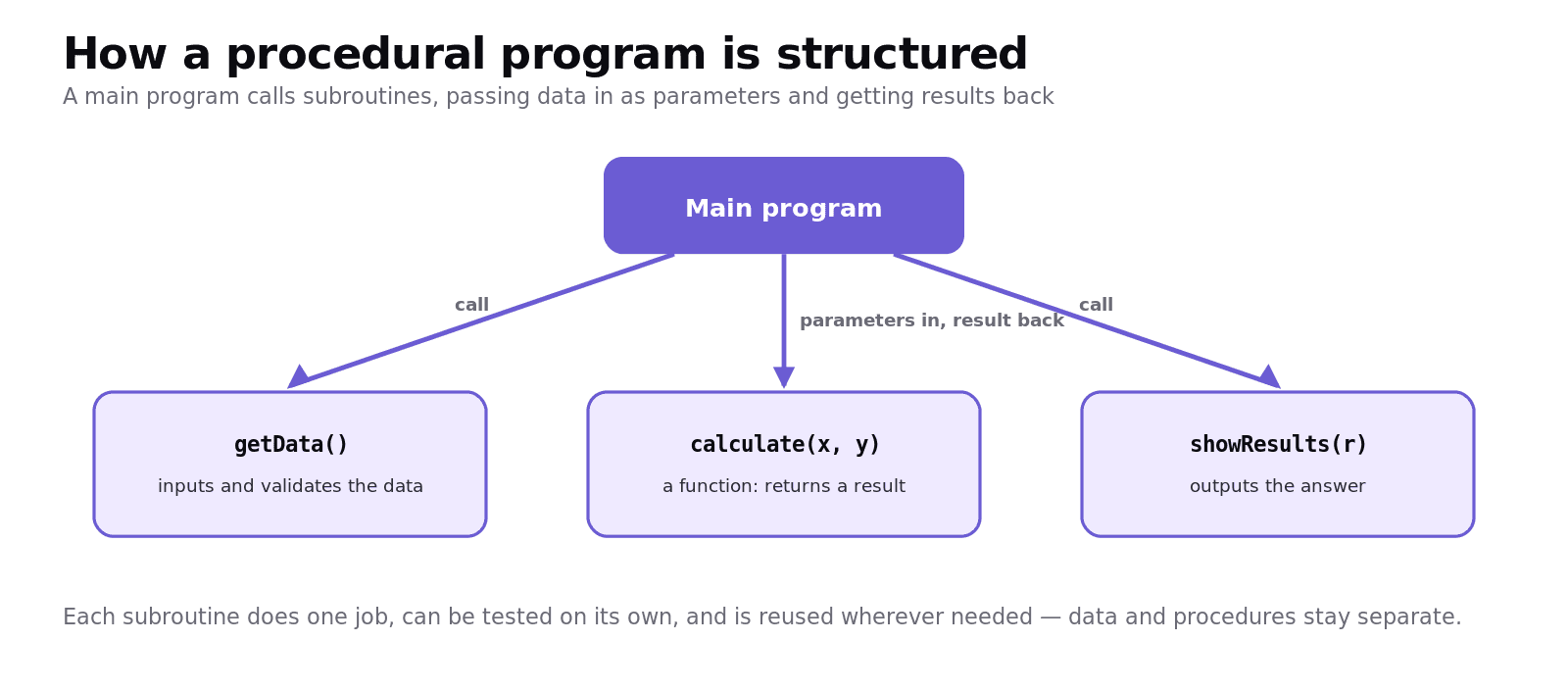
A procedural language structures a program as a series of instructions executed in order, grouped into subroutines (procedures and functions) that can be called when needed. Key characteristics:
Instructions run in sequence, with selection (if) and iteration (loops) controlling the flow — the classic structured-programming building blocks.
The program is decomposed into subroutines, each doing one job, which can be reused and tested separately.
Data and procedures are kept separate: data is passed into subroutines as parameters, unlike object-oriented code where data and methods live together.
Examples include Python, C and Pascal when written in a procedural style.
Worked example: a small procedural program
A program reads two numbers and outputs the first divided by the second, refusing to divide by zero:
The logic is a top-to-bottom sequence with a selection in the middle, wrapped in a procedure — exactly the procedural pattern OCR expects you to write in pseudocode.
When does a procedural approach suit best?
Procedural code shines when a task is a clear sequence of steps: processing a file, running a calculation, working through a batch of records. It is simple to follow and efficient. For very large systems with many interacting "things" (users, products, game characters), the object-oriented paradigm usually scales better — which is why OCR loves asking you to compare them.
Common exam mistakes
Defining a paradigm as "a language". A paradigm is a style/approach to programming; a language may support several paradigms.
Saying procedural means "no structure". It is highly structured — sequence, selection, iteration, and subroutines.
Forgetting why paradigms exist. Different problems suit different approaches; levels of abstraction trade ease against control.
Confusing procedural and declarative. Procedural says how, step by step; declarative says what and lets the language work out how.
Listing examples without characteristics. "Describe the characteristics" needs the features, not just language names.
Quick recap
A paradigm is a style of programming; several exist because different problems suit different approaches.
Procedural: step-by-step instructions, structured with sequence, selection, iteration and subroutines; data passed as parameters.
Other paradigms: object-oriented (objects combine data + behaviour), declarative (describe what, not how), low-level/assembly (maximum control).
Procedural suits clear step-by-step tasks; OOP scales better for systems of many interacting objects.
Frequently asked questions
What is a programming paradigm? A paradigm is a style or approach to structuring programs, such as procedural, object-oriented, declarative or low-level. It describes how the programmer thinks about and organises a solution, not a specific language.
Why do different programming paradigms exist? Because different kinds of problem are solved most naturally in different ways, and because languages at different levels of abstraction trade ease of development against control over the hardware. No single style suits everything.
What is a procedural language? A procedural language structures a program as a sequence of instructions organised into procedures and functions. The flow is controlled by sequence, selection and iteration, and data is passed to subroutines as parameters.
What are examples of procedural languages? C and Pascal are classic procedural languages, and Python is commonly written in a procedural style. Many modern languages support several paradigms, including procedural.
What is the difference between procedural and declarative programming? Procedural code tells the computer how to solve a problem step by step. Declarative code, such as SQL, states what result is wanted and leaves the language to decide how to produce it.
When is a procedural approach most suitable? When the task is a clear sequence of steps, such as a calculation, file processing or a batch job. For large systems with many interacting entities, an object-oriented approach usually scales better.