Types of OS, BIOS, Device Drivers & Virtual Machines (OCR A-Level CS 1.2.1)
OCR A-Level CS 1.2.1: distributed, embedded, multi-tasking, multi-user and real-time operating systems, plus BIOS, device drivers and virtual machines. Exam tips.

Free OS Types BIOS Drivers VMs revision resources (OCR A-Level Computer Science, 1.2.1)
We’ve made exam-style practice for this exact topic, free to download: OS Types BIOS Drivers VMs question sheet, mark scheme and cheat sheet. Grab them, have a go, then read the full guide below.
Not every operating system is Windows on a laptop. A washing machine, a self-driving car, a university mainframe and a phone all run very different kinds of OS. Spec point 1.2.1 asks you to describe the five types of operating system, plus BIOS, device drivers and virtual machines — favourite Paper 1 questions like "name three types of OS and state the purpose of each" and "describe what the BIOS does to start up the computer".
This guide covers each OS type and the three supporting concepts.
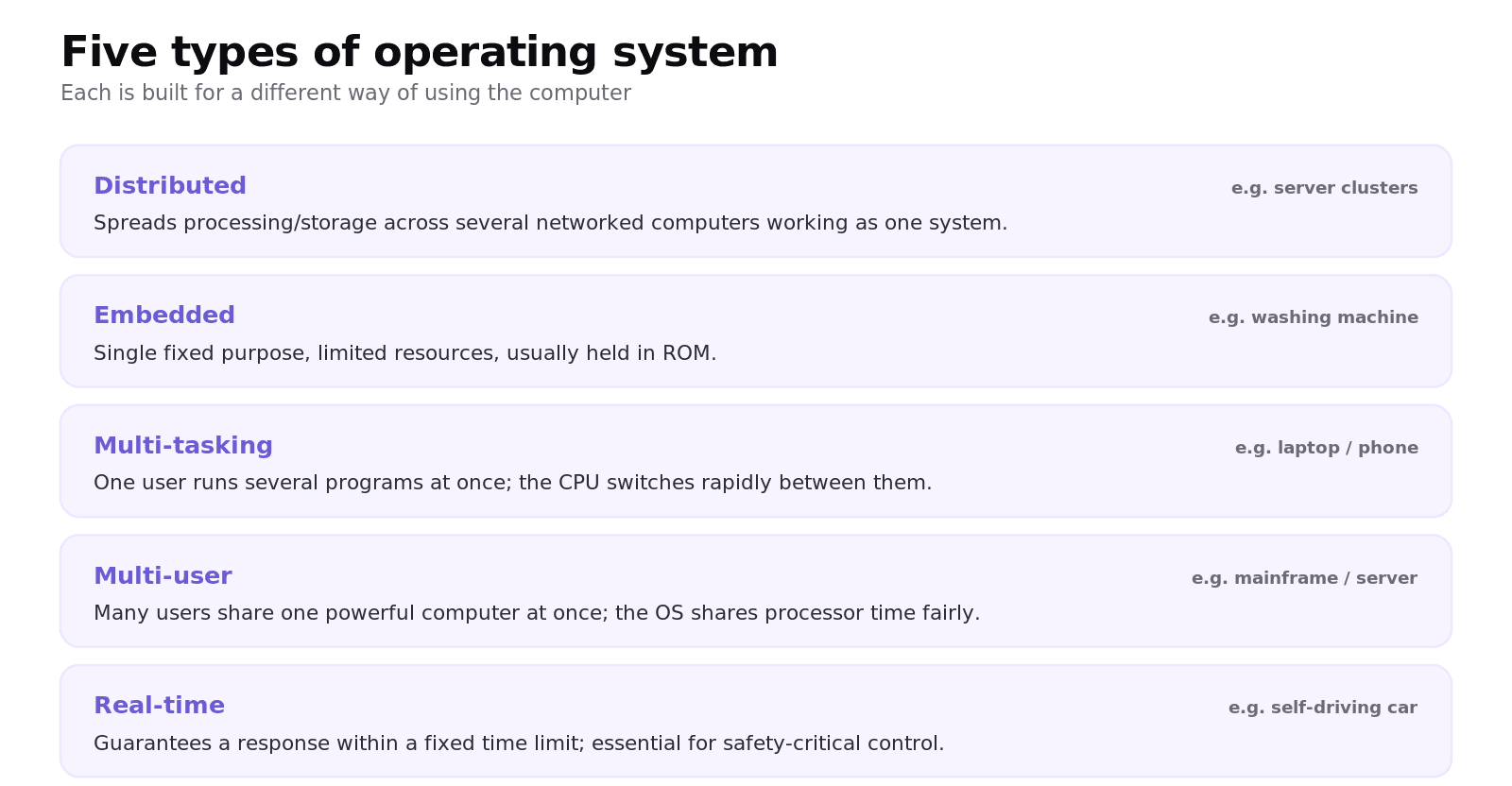
What are the five types of operating system?
Distributed — spreads processing and storage across several networked computers that work together as one system, sharing the load. Used for large systems and clusters.
Embedded — built into a device with a single, fixed purpose, often held in ROM. It uses limited resources and is found in washing machines, microwaves, cameras and other appliances.
Multi-tasking — lets a single user run several programs at once by rapidly switching the CPU between them (using scheduling). This is what a normal PC, laptop or phone does.
Multi-user — lets many users share one powerful computer at the same time, with the OS allocating processor time fairly between them (time-sharing). Used on mainframes and servers.
Real-time — guarantees a response within a fixed time limit, which is essential for safety-critical control where a late response is a failure. Used in self-driving cars, aircraft systems, medical monitors and industrial control.
What is BIOS and what does it do?
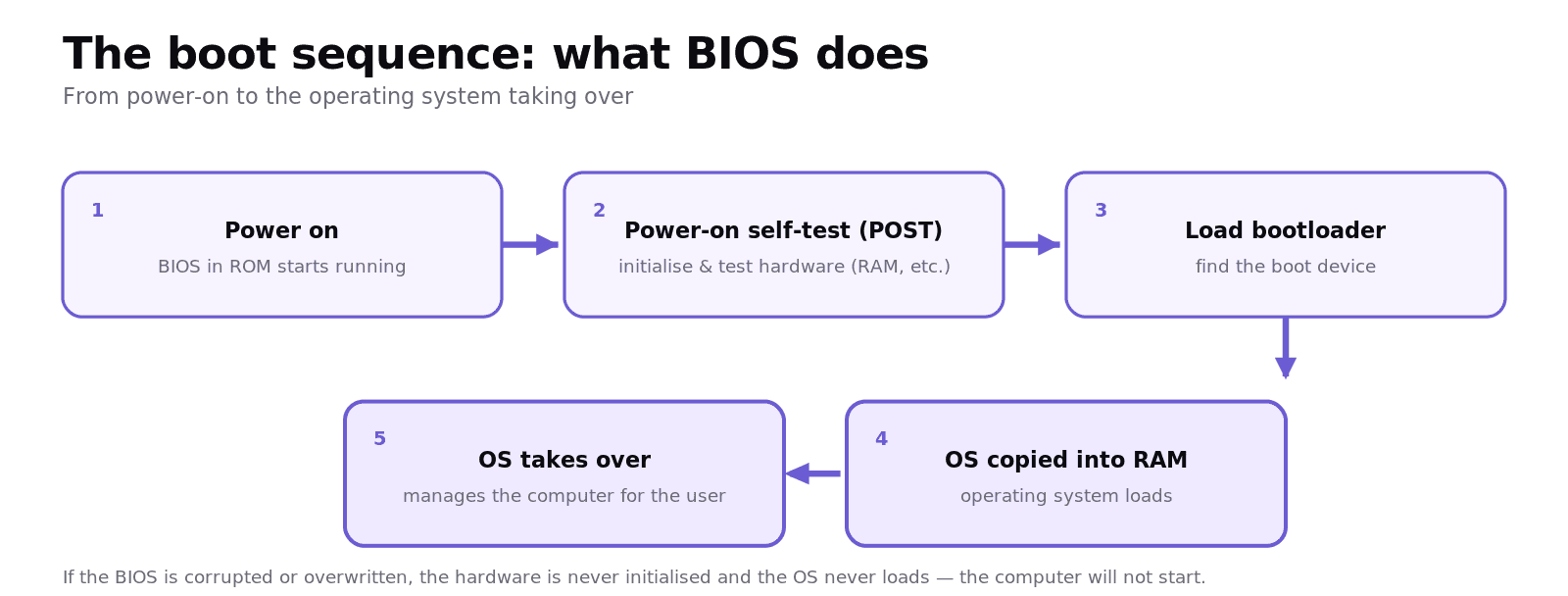
BIOS (Basic Input Output System) is a small program stored in ROM (historically EPROM). When you switch the computer on, the BIOS:
Initialises and tests the hardware with a power-on self-test (POST), checking essentials like RAM and the keyboard.
Locates the boot device and loads the bootloader, which copies the operating system into RAM so it can take over.
Because the BIOS is the very first program to run, if it is corrupted or overwritten the computer cannot start up at all — the hardware is never initialised and the OS is never loaded.
What is a device driver?
A device driver is a small program that gives the operating system a standard way to communicate with a particular hardware device, translating general OS commands into the specific signals that device understands. Without the correct driver, the OS cannot control the hardware properly — which is why connecting a new printer, graphics card or scanner often means installing its driver first.
What is a virtual machine?
A virtual machine (VM) is any situation where software takes on the function of a machine. Two common cases for the exam:
Running intermediate code (bytecode): a program is compiled to platform-independent intermediate code, then a VM (such as the Java Virtual Machine) executes it on any device that has the VM. This makes the program portable across different hardware.
Running one operating system inside another: software emulates a whole computer, so you can run, for example, Linux inside Windows. This is useful for testing software safely, sandboxing, and running incompatible software, though it runs slower than on real hardware.
Common exam mistakes
Confusing multi-tasking and multi-user. Multi-tasking = one user, many programs. Multi-user = many users sharing one machine.
Describing real-time as just "fast". The point is a guaranteed response within a time limit, vital for safety-critical systems.
Saying BIOS "is the operating system". BIOS only initialises hardware and loads the OS; the OS itself is separate, in secondary storage.
Vague driver answers. A driver lets the OS communicate with a specific device; name a device when asked for an example.
Thinking a VM is just an app. It is software acting as a machine — either executing intermediate code or emulating a whole computer.
Quick recap
Distributed (load across networked computers), embedded (fixed-purpose, in ROM), multi-tasking (one user, many programs), multi-user (many users share one machine), real-time (guaranteed response time).
BIOS runs at power-on: POST to test hardware, then loads the bootloader/OS into RAM; corrupt BIOS = no boot.
A device driver lets the OS communicate with a specific hardware device.
A virtual machine is software acting as a machine: running intermediate code (bytecode) for portability, or running an OS inside another for testing and sandboxing.
Frequently asked questions
What are the five types of operating system? Distributed (load spread across networked computers), embedded (single fixed purpose, often in ROM), multi-tasking (one user running several programs at once), multi-user (many users sharing one powerful computer), and real-time (guaranteed response within a fixed time limit).
What is an embedded operating system? An embedded operating system is built into a device with a single, dedicated purpose, such as a washing machine, microwave or camera. It is usually stored in ROM and uses limited memory and processing power.
What is a real-time operating system? A real-time operating system guarantees a response within a fixed time limit. This is essential for safety-critical control systems such as self-driving cars, aircraft and medical monitors, where a late response would count as a failure.
What does BIOS do? BIOS is a small program in ROM that runs when the computer is switched on. It initialises and tests the hardware with a power-on self-test (POST), then loads the bootloader which copies the operating system into RAM.
What is a device driver? A device driver is a program that lets the operating system communicate with a specific hardware device, translating general commands into the signals that device understands. New hardware such as a printer usually needs its driver installed.
What is a virtual machine? A virtual machine is software that takes on the function of a machine. It may execute platform-independent intermediate code (bytecode) so a program runs on any device with the VM, or emulate a whole computer so one operating system can run inside another.