Types of Processor: CISC, RISC, GPUs & Multicore (OCR A-Level CS 1.1.2)
OCR A-Level CS 1.1.2: CISC vs RISC processors, GPUs and their non-graphics uses, and multicore and parallel systems. Worked example, diagrams and exam tips.

Free Types Of Processor revision resources (OCR A-Level Computer Science, 1.1.2)
We’ve made exam-style practice for this exact topic, free to download: Types Of Processor question sheet, mark scheme and cheat sheet. Grab them, have a go, then read the full guide below.
Not all processors are built the same way, and that is the whole point of this topic. Spec point 1.1.2 asks you to compare the main types: the two instruction-set philosophies (CISC and RISC), the graphics-focused GPU, and multicore and parallel systems. Here is what you need to know up front: OCR almost never asks you to simply define these. They ask you to apply them: why a phone uses RISC, why a GPU beats a CPU at graphics, why four cores are not always four times faster. So as you read, do not just memorise the labels. Keep asking yourself "and why does that matter?" That is the question the exam is really testing.
This guide works through each type and the trade-offs you are expected to weigh up.
What is the difference between CISC and RISC processors?
The difference is the size and complexity of the instruction set.
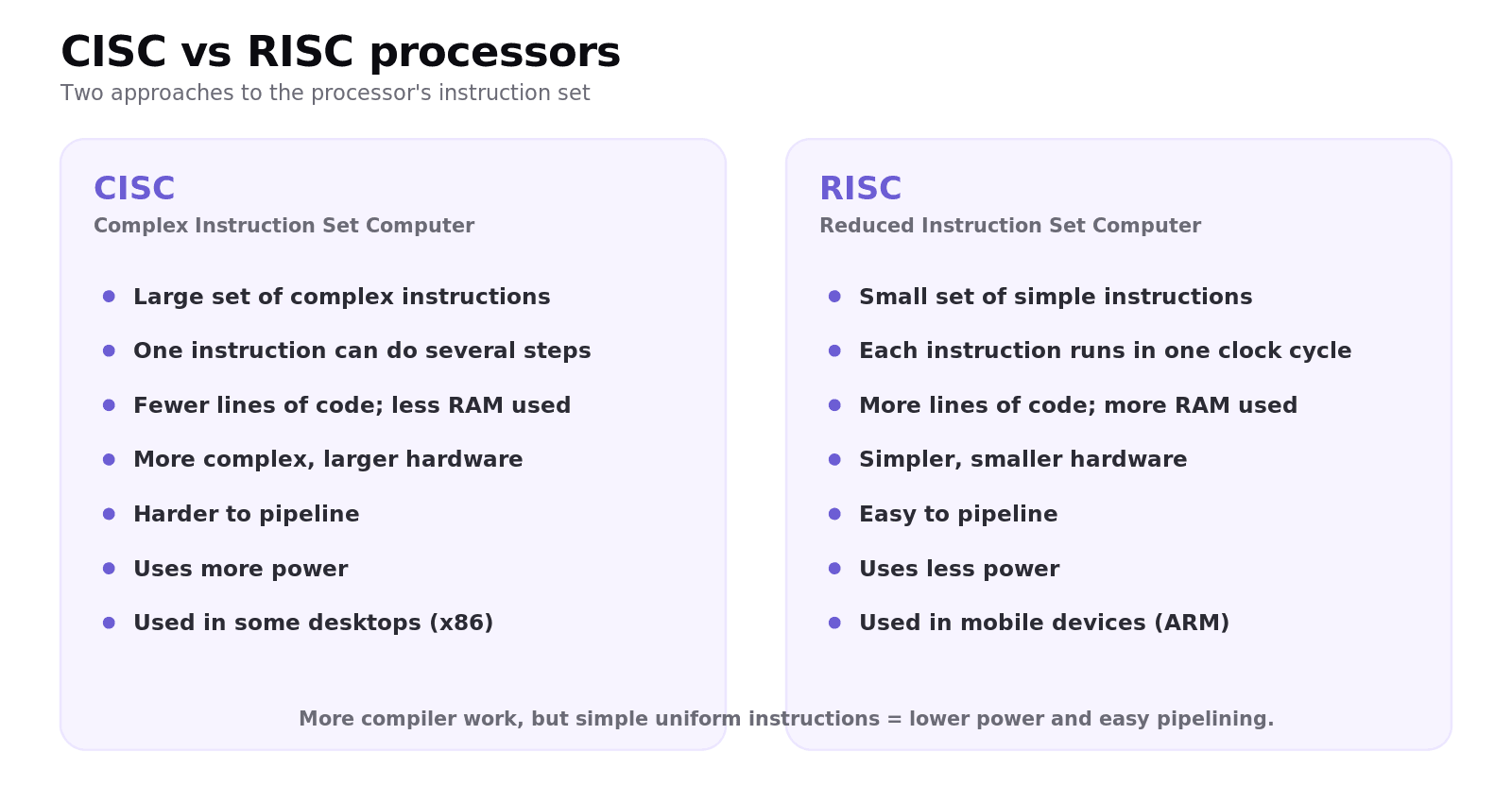
CISC (Complex Instruction Set Computer) uses a large set of complex instructions. A single instruction can do several low-level steps at once, so programs need fewer lines, but the processor hardware is more complicated.
RISC (Reduced Instruction Set Computer) uses a small set of simple instructions, each designed to execute in a single clock cycle. Programs need more lines, but the simpler, uniform instructions are easier to pipeline and use less power.
Worked example
To multiply two values in memory locations A and B, a CISC processor might use one instruction:
A RISC processor breaks the same job into simple steps:
The CISC version is shorter and needs less RAM for the program; the RISC version is longer but each instruction is uniform and fast, so the four instructions can be pipelined and finish at least as quickly.
Why do mobile devices usually use RISC?
Because RISC instructions are simple and uniform, the hardware can be smaller and more power-efficient, and pipelining keeps it busy. Lower power use means less heat and longer battery life, exactly what a phone or tablet needs. That is why most mobile devices use RISC-based (ARM) processors, while CISC lingers in some desktops and embedded microcontrollers.
What is the difference between a CPU and a GPU?
A CPU has a few powerful cores optimised for sequential, decision-heavy work. A GPU (Graphics Processing Unit) has a massively parallel architecture of thousands of smaller, simpler cores designed to apply the same operation to many pieces of data at once.
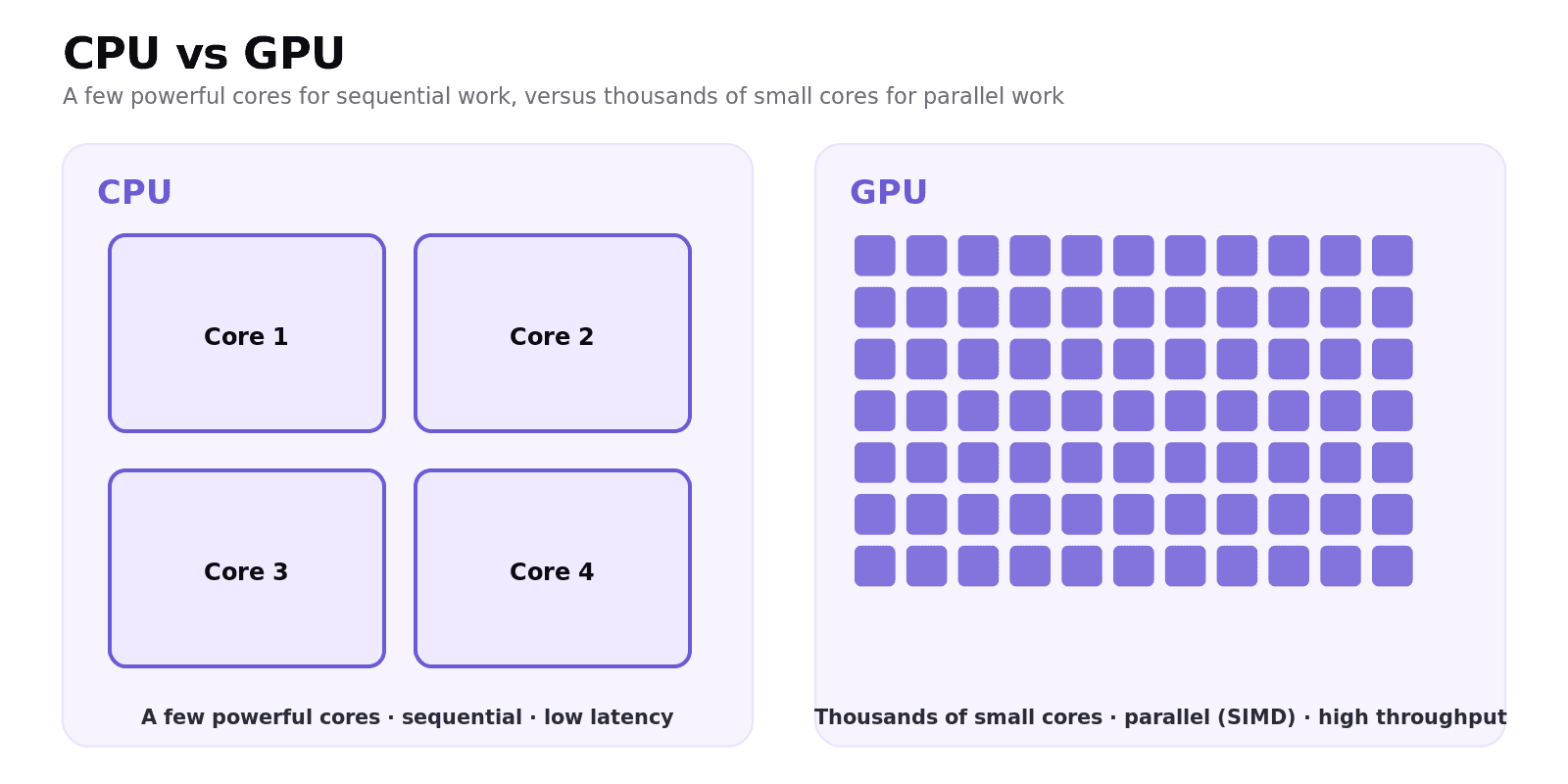
This is the most important part, because it is where the marks really sit: CPUs are built for low latency on varied tasks; GPUs for high throughput on parallel ones. Picture a screen: millions of pixels, with the same shading maths applied to every one of them. A GPU's thousands of cores process them all at once, while a CPU would grind through them in smaller batches. Same problem, completely different tool for the job. Get that contrast and you can answer almost any GPU question they throw at you.
What are GPUs used for beyond graphics?
Because so many scientific and data problems are made of the same calculation repeated over huge datasets, GPUs are now used well beyond games. Common non-graphics uses include machine learning (training models is mostly matrix multiplication), image and video processing, scientific simulation, financial modelling, and tasks like oil and gas exploration. The CPU runs the sequential parts of a program and hands the heavy parallel parts to the GPU.
What are multicore and parallel systems?
A multicore processor places several complete cores on one chip, each with its own fetch-decode-execute cycle, so different instructions run at the same time. Parallel systems take this further, using many processors together: supercomputers may have thousands of cores for weather forecasting, climate models or DNA sequencing.
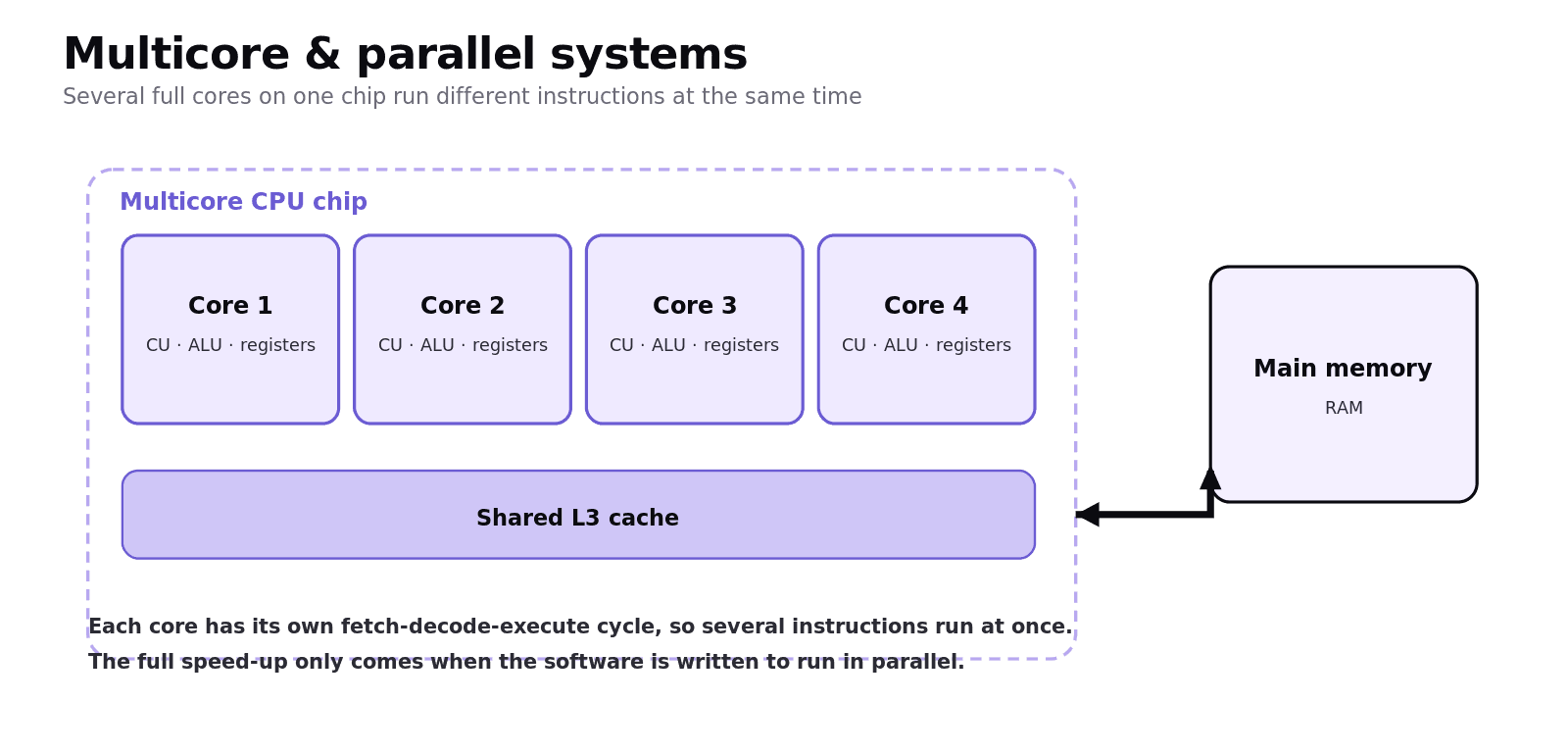
The catch is the same one from performance: the speed-up depends on the software being written to run in parallel. A task that must be done in order, each step relying on the last, cannot be split, so extra cores sit idle.
Common exam mistakes
I see the same handful of slips every year. Read them honestly and ask which one is most likely to be you under exam pressure.
Getting CISC and RISC the wrong way round. CISC = Complex, large instruction set, fewer lines. RISC = Reduced, small instruction set, more lines, one cycle each.
Saying RISC is "just faster". Be specific: simple uniform instructions enable pipelining and use less power, which is why phones use it.
Describing a GPU as "a better CPU". It is not better at everything, only at parallel, repetitive work. CPUs still win on sequential, branching tasks.
Forgetting GPUs have non-graphics uses. Name one (machine learning, simulation) when asked.
Claiming more cores always means proportionally more speed. Only if the software is parallelised.
Quick recap
CISC: large, complex instruction set; fewer lines; more complex hardware. RISC: small, simple, one-cycle instructions; more lines; easy to pipeline; low power.
Mobile devices favour RISC for lower power, less heat and longer battery life.
A GPU has thousands of simple cores for parallel work; a CPU has a few powerful cores for sequential work.
GPUs have non-graphics uses: machine learning, simulation, image processing, finance.
Multicore and parallel systems run instructions at once, but only speed up parallelisable software.
One last thing, and it is the habit that turns a C into an A here: every one of these types is a trade-off, never a clear winner. RISC trades shorter programs for lower power. A GPU trades flexibility for raw parallel speed. When a question says "discuss" or "evaluate", that is your cue to give both sides. Do that and you are not memorising facts any more. You are thinking like a computer scientist. I believe in you.
Frequently asked questions
What do CISC and RISC stand for? CISC is Complex Instruction Set Computer and RISC is Reduced Instruction Set Computer. The names describe the size and complexity of the instruction set each uses.
What is the main difference between CISC and RISC processors? CISC uses a large set of complex, multi-step instructions, so programs are shorter but the hardware is more complex. RISC uses a small set of simple instructions that each run in one clock cycle, so programs are longer but easier to pipeline and more power-efficient.
Why do smartphones usually use RISC processors? RISC's simple, uniform instructions allow smaller, more power-efficient hardware and effective pipelining. Lower power consumption means less heat and longer battery life, which is essential for a mobile device.
What is the difference between a CPU and a GPU? A CPU has a few powerful cores optimised for sequential and decision-heavy tasks. A GPU has thousands of smaller cores that apply the same operation to many data items at once, making it far faster for parallel work like graphics.
What are GPUs used for besides graphics? Non-graphics uses include machine learning, image and video processing, scientific simulation, financial modelling and applications such as oil exploration, all of which repeat the same calculation across large datasets.
Why isn't a multicore processor always faster than a single-core one? Because the speed-up depends on the software being written to run in parallel. Tasks that must run in sequence cannot be split across cores, so the additional cores sit idle and provide little benefit.