Ethical Considerations in AI (IB CS A4.4): A Complete Guide
IB Computer Science A4.4 explained: bias and fairness, privacy, transparency, accountability, jobs, and the environmental impact of machine learning and AI.

Machine learning can do real good and real harm, often with the same system. Topic A4.4 closes Theme A by asking you to discuss the ethics of machine learning and of computers becoming ever more woven into society. Because the command word is usually "discuss", the marks go to balanced answers that weigh benefits against risks.
This guide covers both A4.4 understandings: the ethical implications of machine learning in real-world applications, and the ethical aspects of the growing integration of computer systems into our lives.
What does IB CS topic A4.4 cover?
A4.4 has two understandings, both phrased as discuss: the ethical implications of machine learning in real-world applications, and the ethical aspects of the increasing integration of computer systems into society. There is no single right answer; you are assessed on how well you argue, using specific issues and real examples.
What are the main ethical issues with machine learning?
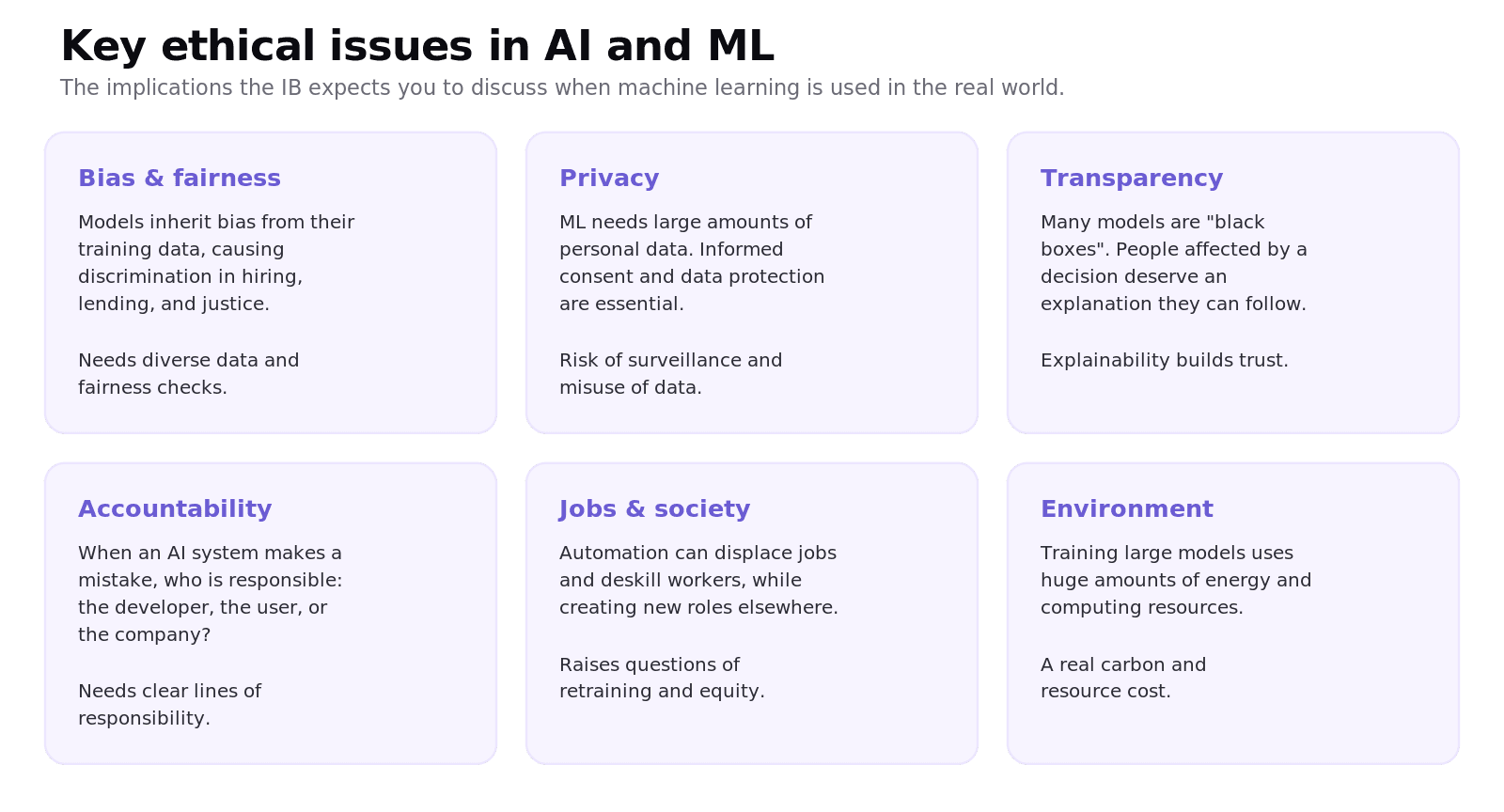
A strong answer names specific issues rather than saying "AI is dangerous". The key ones are bias and fairness, privacy, transparency, accountability, jobs and society, and environmental impact, summarised in the diagram above.
Each is a genuine tension, not a one-sided problem. The same recommendation system that invades privacy also helps people discover useful things; the same automation that displaces some jobs creates others. Good discussion answers hold both sides.
How does bias get into a machine learning system?
This is the issue examiners ask about most, and the crucial point is that the bias usually comes from the data, not from malice in the code.
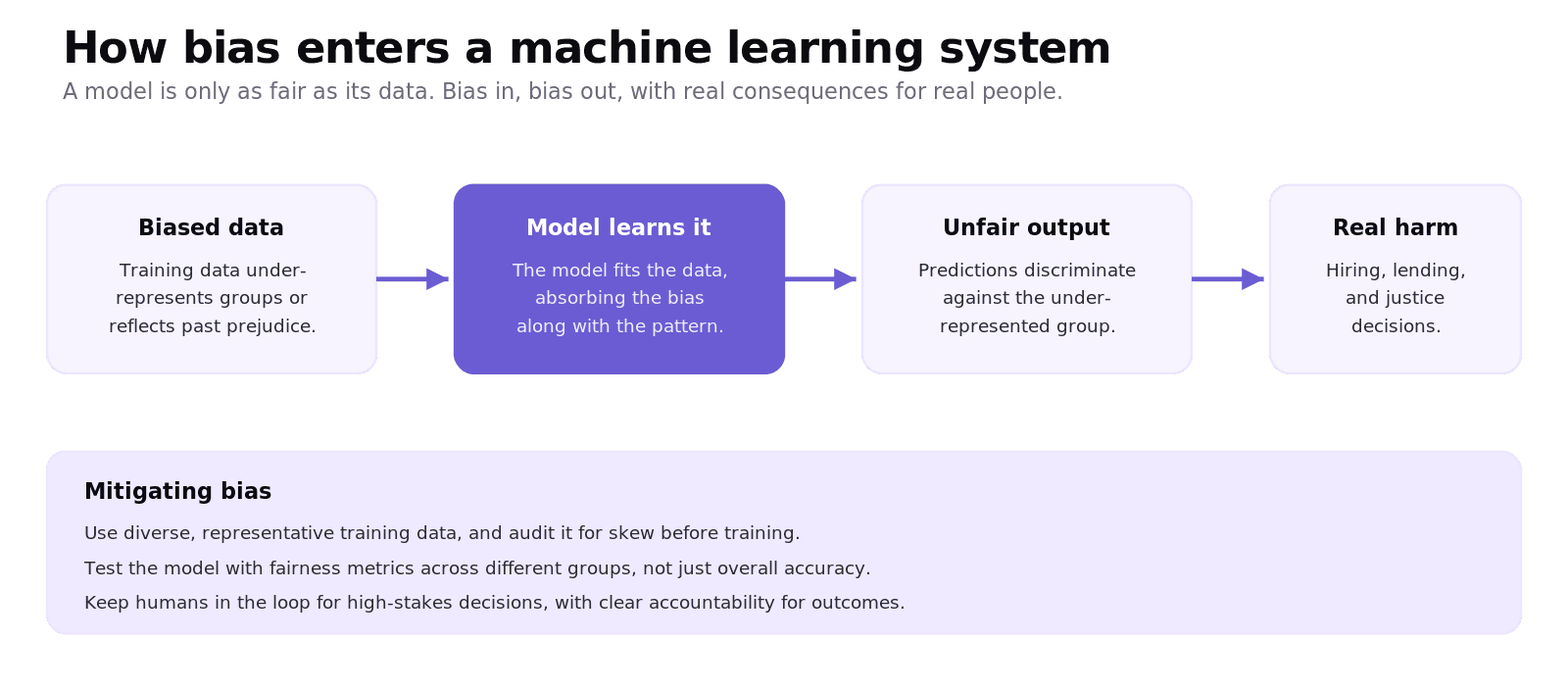
If the training data under-represents a group or reflects past prejudice, the model fits that data and absorbs the bias along with the genuine pattern. Its predictions then discriminate, with real consequences in hiring, lending, and criminal justice. The fix is at the data and process level: use diverse, representative data, audit it for skew, test the model with fairness metrics across groups rather than only overall accuracy, and keep humans in the loop for high-stakes decisions.
Why does privacy matter in AI?
Machine learning is hungry for data, and much of that data is personal. That creates a tension between building useful models and protecting people's privacy, which is a fundamental right.
Ethical use means collecting only the data you need, obtaining informed consent about how it will be used, and protecting it properly. The risks are concrete: mass data collection enables surveillance, and leaked or misused data can harm the very people whose data trained the system. This matters most in sensitive areas like health and finance.
Who is accountable when AI makes a mistake?
Accountability asks a simple but hard question: when an AI system gets something wrong, who is responsible? The developer who built it, the user who deployed it, or the organisation that profits from it?
This matters because many systems make consequential decisions, and a "black box" that no one is answerable for is dangerous. This is why transparency and explainability are linked to accountability: if a decision can be explained, it can be challenged, and responsibility can be assigned. Clear lines of accountability should be set before a system is deployed, not after it fails.
How can we build responsible AI?
The issues above each have a corresponding safeguard, and pairing problem with safeguard is exactly what a top discussion answer does.
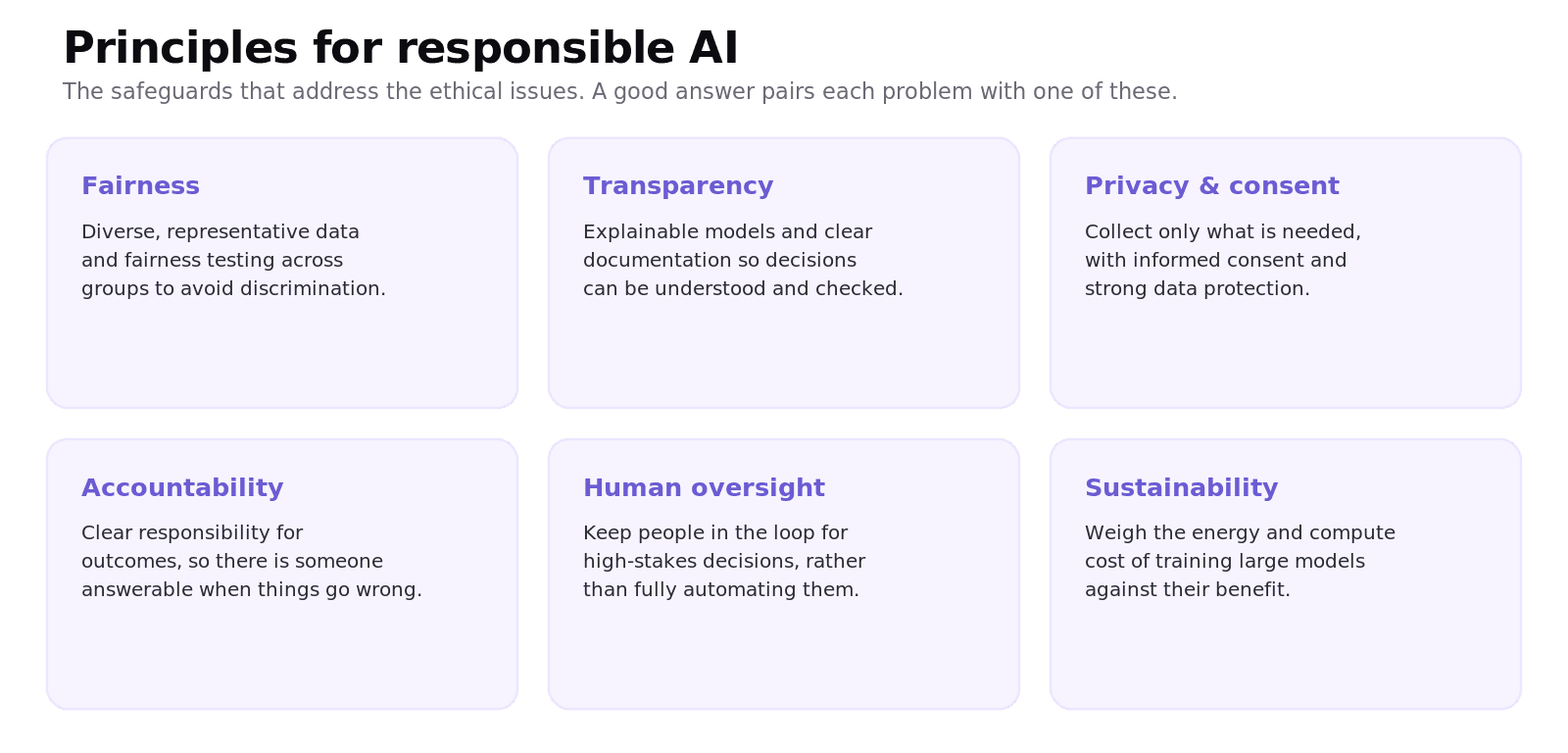
The principles are fairness (diverse data and fairness testing), transparency (explainable models and documentation), privacy and consent (collect only what is needed, with permission), accountability (clear responsibility for outcomes), human oversight (people stay in the loop for important decisions), and sustainability (weighing the energy cost of large models against their benefit). None of these removes the trade-offs, but together they make AI more trustworthy.
Worked example: discussing an AI used to shortlist job applicants
Suppose a company uses ML to shortlist CVs. A balanced discussion would note the benefits (faster screening, consistency, lower cost) and then the risks: the model may inherit bias from past hiring data and discriminate; candidates cannot see why they were rejected (transparency); and it is unclear who is accountable for an unfair rejection. A strong conclusion proposes safeguards, such as auditing the training data, explaining decisions, and keeping a human reviewer, rather than simply declaring the system good or bad.
Common exam mistakes for IB CS A4.4
Giving only one side. The command word is discuss, so weigh benefits against risks.
Being vague ("AI is bad"). Name specific issues: bias, privacy, accountability, and so on.
Blaming the algorithm for bias. Bias usually comes from the data, not the code.
Ignoring accountability and transparency, which are central to the topic.
Not grounding the answer in a real application, such as hiring, healthcare, or policing.
Quick recap of A4.4
A4.4 asks you to discuss the ethics of machine learning and of computers in society; balance matters.
Key issues: bias and fairness, privacy, transparency, accountability, jobs, and environmental impact.
Bias usually enters through the training data, leading to discriminatory outcomes.
Safeguards include diverse data, fairness testing, consent, explainability, and human oversight.
Always link the discussion to a real-world application and weigh both sides.
Frequently asked questions
What are the ethical concerns of machine learning?
The main concerns are bias and unfairness, threats to privacy, a lack of transparency in how decisions are made, unclear accountability when systems fail, the impact on jobs, and the environmental cost of training large models. Each involves a trade-off between benefits and risks.
How does bias enter an AI system?
Bias usually comes from the training data rather than the code. If the data under-represents a group or reflects past prejudice, the model learns that bias and reproduces it in its predictions, leading to discriminatory outcomes.
Why is transparency important in AI?
Transparency means a system's decisions can be understood and explained rather than coming from an unexplained "black box". It matters because people affected by a decision deserve to understand it, and because a decision that can be explained can be challenged and corrected.
Who is responsible when an AI makes a mistake?
Accountability is often unclear and may fall on the developers, the users, or the organisation deploying the system. The ethical position is that clear lines of responsibility should be established before a system is deployed, especially for high-stakes decisions.
How can AI bias be reduced?
Bias can be reduced by using diverse and representative training data, auditing data for skew, testing models with fairness metrics across different groups rather than just overall accuracy, and keeping humans involved in important decisions.
What is the environmental impact of AI?
Training large machine learning models consumes substantial energy and computing resources, which has a real carbon and resource cost. Ethical use means weighing that environmental impact against the benefits the model provides.
Looking for a printable summary? Grab the A4.4 Shuttle Learning revision sheet, a three-page knowledge organiser covering everything above.
Looking for an IB Computer Science tutor?
Hi, I'm Yuness, the tutor behind Shuttle Learning. I work one to one with IB Computer Science students at SL and HL, and I deliberately take on only a handful each year so every student gets my full attention. Most go on to earn the 6s and 7s they were aiming for, in the final exams and the IA alike.
If you would like that kind of support, book a free 15-minute call and tell me what you are stuck on. You can press BOOK A LESSON .