Data Transmissions (IB CS A2.3): A Complete Guide
IB Computer Science A2.3 explained: IPv4 vs IPv6, public and private IP, transmission media, packet switching, and static vs dynamic routing. Diagrams and exam tips.

Knowing what a network is gets you only so far; A2.3 is about how data actually moves across it. It covers how devices are addressed, what the data travels through, and how it finds its way to the right place. Once packet switching clicks, the rest of networking stops feeling like magic.
This guide covers every A2.3 understanding: IP addressing, transmission media, packet switching, and routing.
What does IB CS topic A2.3 cover?
A2.3 has four understandings: the different types of IP addressing, a comparison of transmission media, how packet switching sends data across a network, and how static and dynamic routing move data. Together they explain how a message is labelled, carried, and steered from sender to receiver.
What are the different types of IP address?
An IP address uniquely identifies a device on a network, and there are two versions plus a couple of important distinctions.
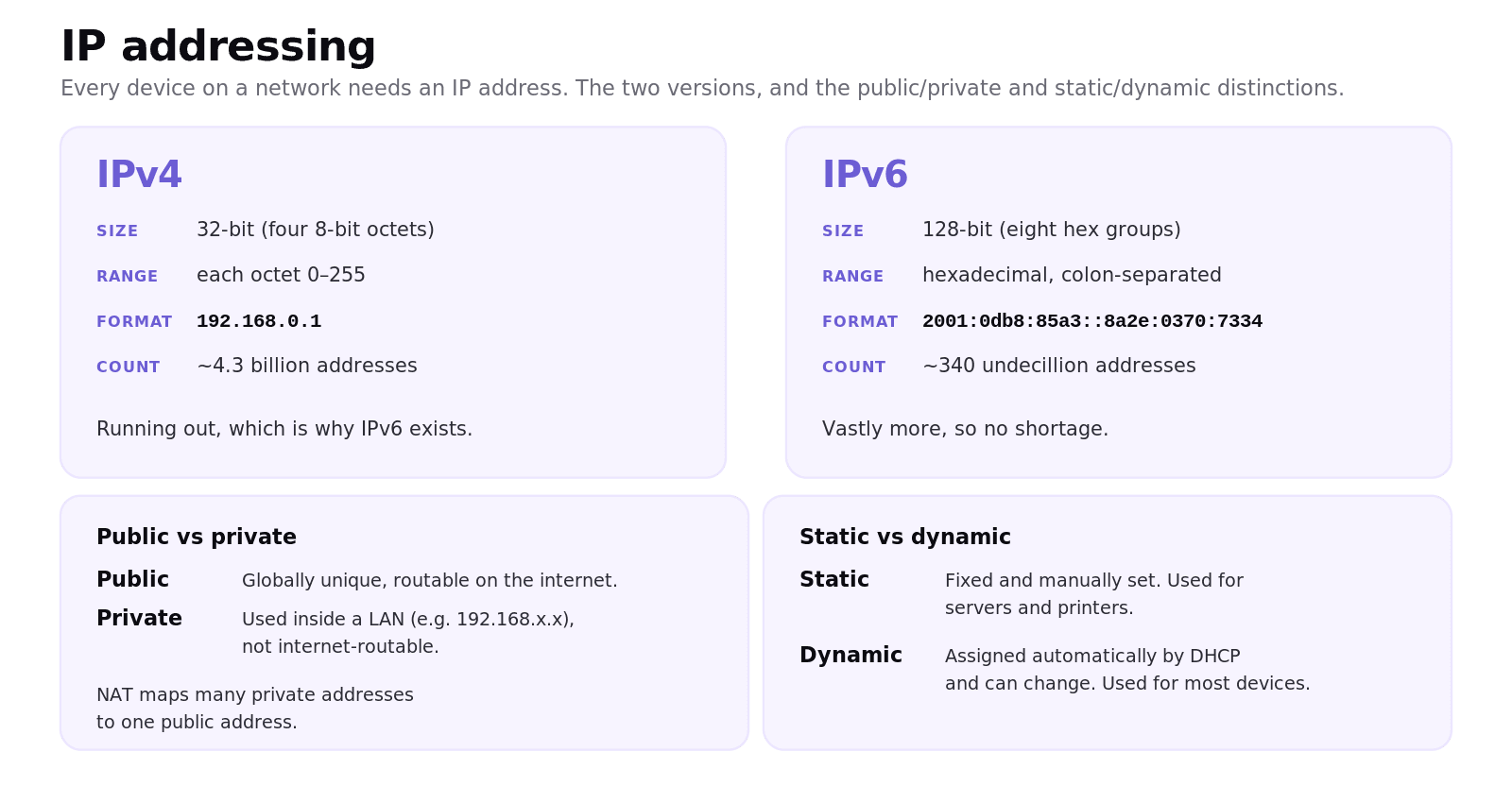
IPv4 is a 32-bit scheme written as four numbers (octets) from 0 to 255, such as 192.168.0.1, giving about 4.3 billion addresses. Because that supply is running out, IPv6 uses a 128-bit scheme written as eight groups of hexadecimal, such as 2001:0db8:85a3::8a2e:0370:7334, giving roughly 340 undecillion addresses.
Addresses are also either public (globally unique and routable on the internet) or private (used inside a LAN, like 192.168.x.x, and not routable on the internet). NAT (Network Address Translation) lets many private addresses share one public address. Finally, an address can be static (fixed and manually set, good for servers) or dynamic (assigned automatically by DHCP and able to change, used for most everyday devices).
What are the types of transmission media?
Transmission media is what the data physically travels through. The IB splits it into three wired types and one wireless.
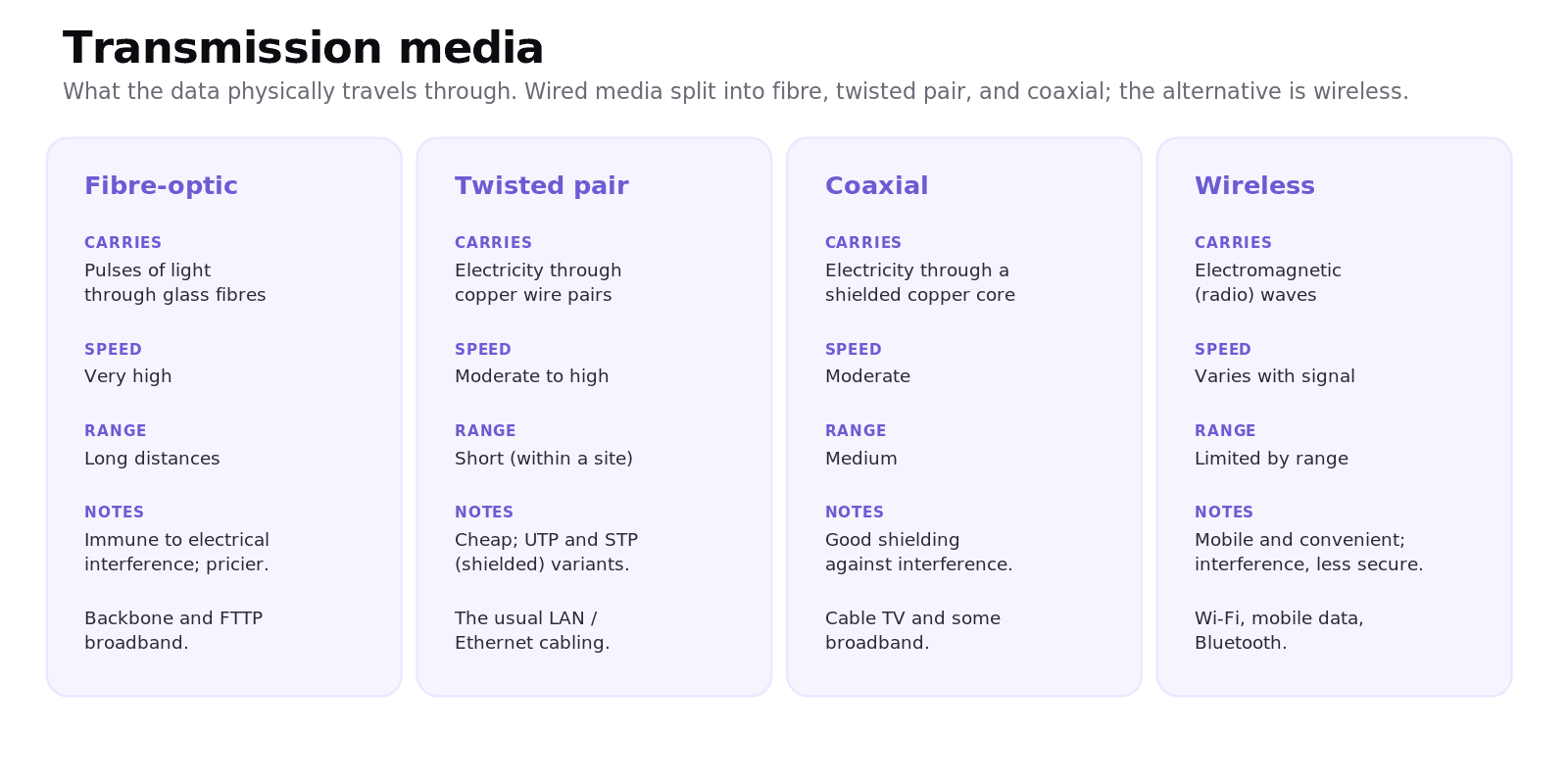
Fibre-optic carries pulses of light through glass fibres, giving very high speeds over long distances and immunity to electrical interference, at a higher cost. Twisted pair carries electricity through pairs of copper wires (UTP or shielded STP); it is cheap and is the usual Ethernet/LAN cabling, but slower and shorter-range than fibre. Coaxial uses a shielded copper core and is common in cable broadband. Wireless uses electromagnetic (radio) waves; it is mobile and convenient but more prone to interference and less secure.
How does packet switching work?
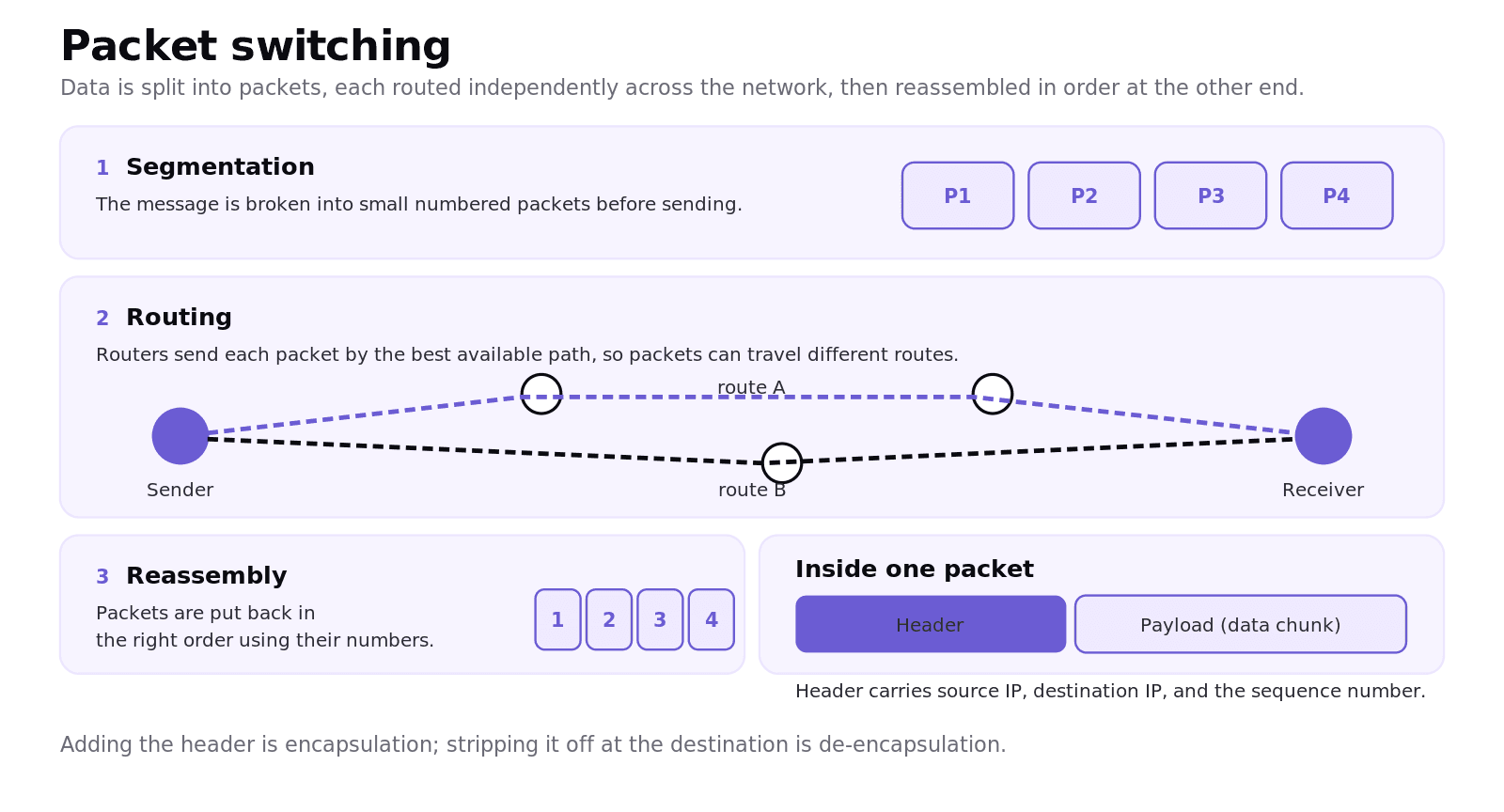
Packet switching sends data by breaking it into small chunks called packets and routing each one separately. It happens in three stages.
First, segmentation: the message is split into numbered packets, and each is wrapped with a header (this wrapping is called encapsulation). Each packet's header holds the source IP, the destination IP, and a sequence number, while the payload carries a chunk of the actual data. Second, routing: routers forward each packet along the best available path, so different packets can take different routes and even arrive out of order. Third, reassembly: at the destination the headers are stripped off (de-encapsulation) and the sequence numbers are used to put the packets back in order.
Worked example: sending a photo
Imagine emailing a photo. The file is segmented into, say, four packets numbered 1 to 4. Packets 1 and 3 might travel one route while 2 and 4 take another, depending on network traffic. They could arrive as 1, 3, 2, 4, but the sequence numbers let the receiver rebuild the photo as 1, 2, 3, 4. No single route is reserved, which is what makes packet switching efficient and resilient.
What is the difference between static and dynamic routing?
Routing is how routers decide where to send packets next. With static routing, the routes are configured manually and do not change unless an administrator updates them; it is simple and predictable but does not adapt if a link fails. With dynamic routing, routers share information and update their routing tables automatically, choosing the best path as conditions change; it is more resilient and scalable but more complex. Large networks like the internet rely on dynamic routing.
Common exam mistakes for IB CS A2.3
Confusing the bit sizes: IPv4 is 32-bit, IPv6 is 128-bit.
Mixing up public and private IP addresses. Private addresses are not routable on the internet.
Confusing static/dynamic IP addresses with static/dynamic routing. They are two different uses of the same words.
Saying every packet takes the same path. In packet switching, packets can travel different routes and arrive out of order.
Confusing packet switching with circuit switching, which reserves a single dedicated path for the whole transmission.
Forgetting that fibre is immune to electrical interference and that wireless is the least secure medium.
Quick recap of A2.3
An IP address identifies a device: IPv4 (32-bit) or IPv6 (128-bit), and either public/private or static/dynamic.
NAT lets many private addresses share one public address; DHCP hands out dynamic addresses.
Transmission media: fibre-optic (fast, long, immune to interference), twisted pair (cheap LAN cabling), coaxial, and wireless (mobile, less secure).
Packet switching splits data into numbered packets that are routed separately and reassembled in order.
Static routing is fixed and manual; dynamic routing adapts automatically.
Frequently asked questions
What is the difference between IPv4 and IPv6?
IPv4 is a 32-bit addressing scheme written as four numbers from 0 to 255 (like 192.168.0.1), giving about 4.3 billion addresses. IPv6 is a 128-bit scheme written as eight hexadecimal groups, giving roughly 340 undecillion addresses, which solves the IPv4 shortage.
What is the difference between a public and private IP address?
A public IP address is globally unique and routable on the internet. A private IP address (such as 192.168.x.x) is used only inside a local network and is not routable on the internet; NAT translates between private addresses and a shared public one.
What is packet switching?
Packet switching is a method of sending data by splitting it into small numbered packets, each routed independently across the network and reassembled in order at the destination. It is efficient and resilient because no single path is reserved for the whole message.
What is the difference between static and dynamic routing?
Static routing uses routes set manually that do not change unless an administrator updates them, which is simple but inflexible. Dynamic routing lets routers update their routing tables automatically to find the best path as conditions change, which is more resilient and is used on large networks.
Why is fibre-optic faster than copper cables?
Fibre-optic carries data as pulses of light through glass fibres, which allows much higher speeds over longer distances than the electrical signals used in copper twisted pair or coaxial cables. It is also immune to electrical interference, though it costs more.
What is NAT?
NAT (Network Address Translation) is a technique, usually run on a router, that lets many devices with private IP addresses share a single public IP address. The router swaps the private source address for its public one on outgoing packets and reverses it on the replies.
Looking for a printable summary? Grab the A2.3 Shuttle Learning revision sheet, a three-page knowledge organiser covering everything above.
Looking for an IB Computer Science tutor?
Hi, I'm Yuness, the tutor behind Shuttle Learning. I work one to one with IB Computer Science students at SL and HL, and I deliberately take on only a handful each year so every student gets my full attention. Most go on to earn the 6s and 7s they were aiming for, in the final exams and the IA alike.
If you would like that kind of support, book a free 15-minute call and tell me what you are stuck on. You can press BOOK A LESSON .