Network Architecture (IB CS A2.2): A Complete Guide
IB Computer Science A2.2 explained: network topologies, the function of servers, client-server vs peer-to-peer, and network segmentation. Examples and exam tips.
Once you know what a network is, the next question is how to design one. Topic A2.2 is about the shape and structure of networks: how the devices are wired together, what roles they play, and how the whole thing is divided up. These are the design decisions that determine whether a network is fast, reliable, and secure.
This guide covers every A2.2 understanding: network topologies, the function of servers, the client-server and peer-to-peer models, and network segmentation.
What does IB CS topic A2.2 cover?
A2.2 has four understandings: the functions and practical applications of network topologies, the function of servers, a comparison of networking models, and the concepts and applications of network segmentation. In short, it is the architecture layer: how a network is laid out, who provides services, and how it is partitioned.
What is a network topology?
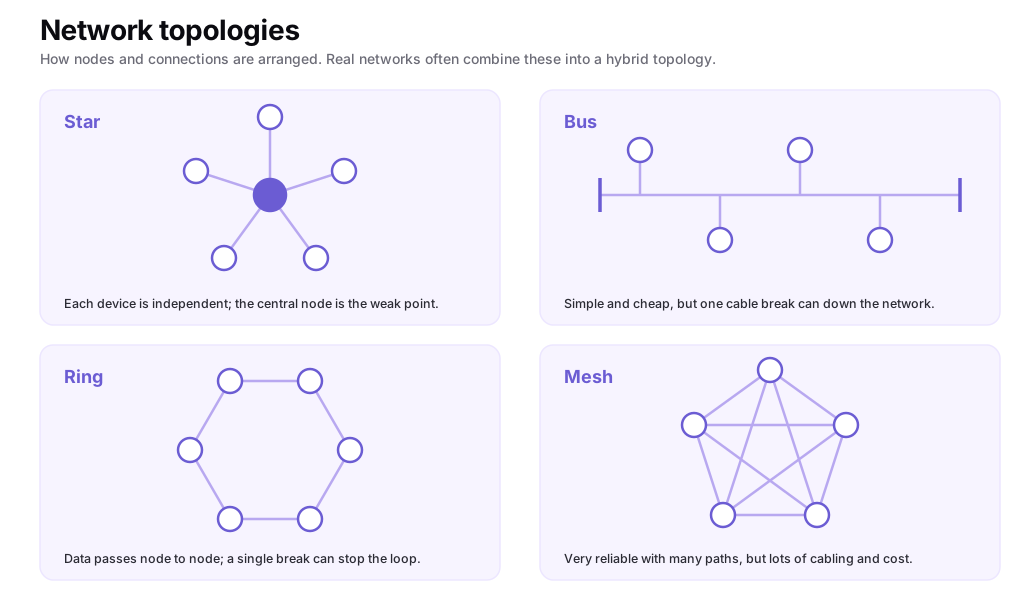
A topology is the arrangement of the devices, called nodes, and the connections between them. The classic shapes each trade cost against reliability.
A star topology connects every device to a central node such as a switch. It is easy to expand and a failed device only isolates itself, but the central node is a single point of failure, and most home and office LANs use it. A bus topology connects every device to one shared backbone cable; it is cheap, but a single break can take the whole network down. A ring topology links each node to the next in a loop, so data passes node to node, and a break can stop the ring. A mesh topology connects nodes to many others, giving multiple paths and very high reliability at the cost of a lot of cabling. Real networks usually combine these into a hybrid topology, for example several star LANs joined by a mesh backbone.
What do servers do?
A server is not necessarily a powerful machine; it is a role. It is hardware or software that hosts, delivers, and manages a resource that other devices, the clients, request.
Common servers each provide one service. A web server delivers web pages over HTTP and HTTPS. A file server stores and shares files. A mail server sends and receives email. A print server manages shared printers. A DNS server translates human-readable domain names into IP addresses. A database server stores and serves structured data. Because servers centralise a resource, they make management, security, and backups easier, but they also concentrate risk in one place.
Worked example: how a DNS server resolves a domain
When you type shuttlelearning.com, your computer needs its IP address before it can connect.
Step 1. Your computer asks its local DNS server (the resolver) for the IP address.
Step 2. If the resolver does not have it cached, it queries a root DNS server, which points it toward the right authoritative server.
Step 3. The resolver queries the authoritative DNS server for the domain, which returns the IP address.
Step 4. The resolver caches the answer for next time and returns it to your browser, which then connects to the web server at that IP.
This back-and-forth, where the resolver chases the answer down the hierarchy, is called recursion.
What is the difference between client-server and peer-to-peer?
These are the two networking models, and the difference is whether one machine is in charge.
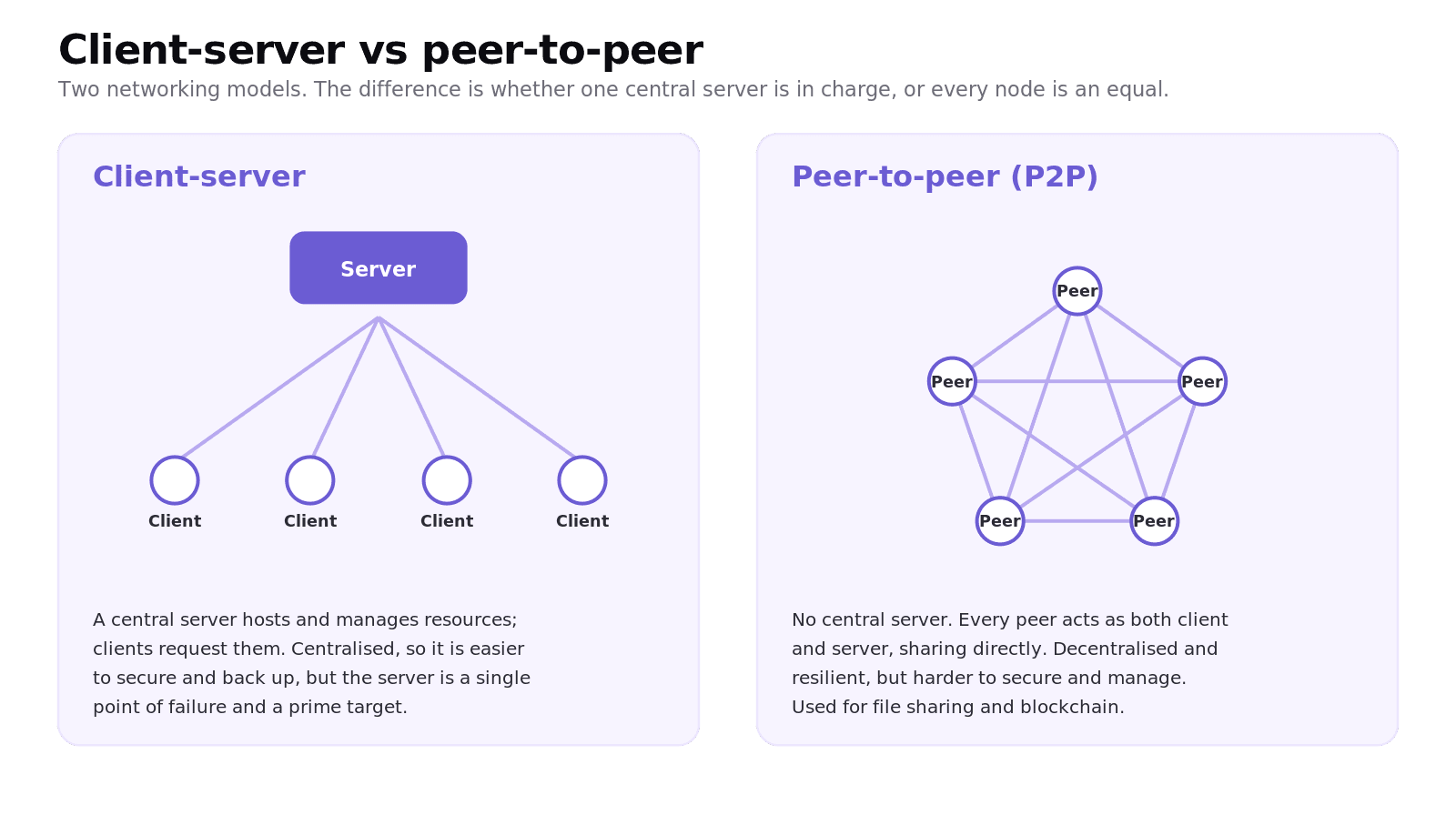
In the client-server model, a central server hosts and manages the resources, and clients request them. It is centralised, which makes security, updates, and backups easier to control, but the server is a single point of failure and a prime target for attackers. In the peer-to-peer (P2P) model there is no dedicated server: every peer acts as both client and server, sharing resources directly. It is decentralised, which makes it resilient and cheap to set up, but harder to secure and manage. P2P powers file-sharing networks, blockchain, and some messaging systems.
What is network segmentation and why is it used?
Network segmentation divides one network into smaller, isolated parts called subnets or VLANs (virtual LANs). Traffic between segments must pass through a router or firewall, so the segments are not directly exposed to each other.
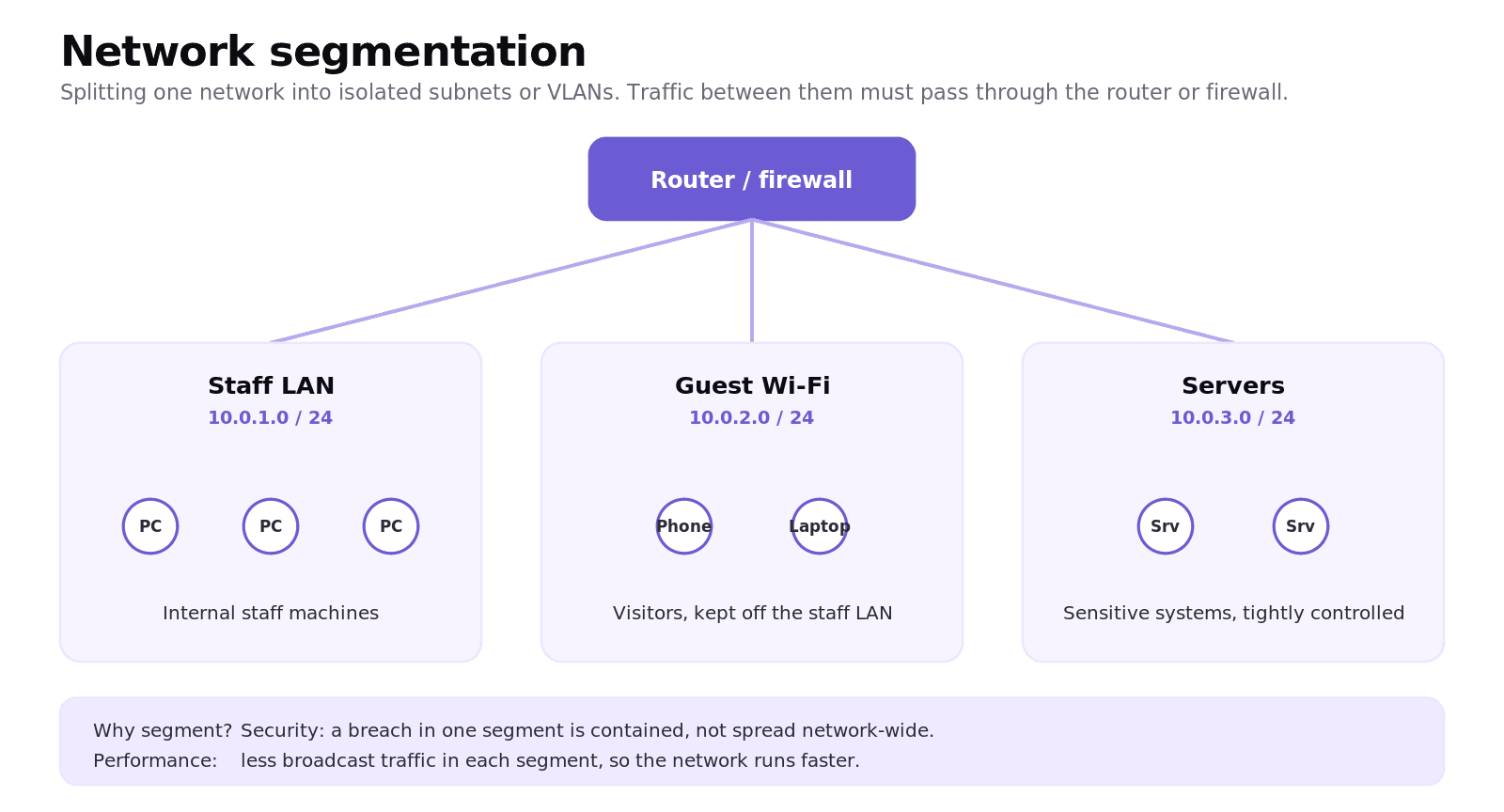
Segmentation improves security: if one segment is breached, the damage is contained rather than spreading across the whole network. It also improves performance, because each segment carries less broadcast traffic, so the network runs faster. A typical example keeps staff machines, guest Wi-Fi, and servers on separate subnets, so a compromised guest device cannot reach sensitive internal systems.
Common exam mistakes for IB CS A2.2
Confusing a star and a mesh topology. A star has one central node; a mesh has many direct connections between nodes.
Saying mesh is always the best choice. It is the most reliable, but the cabling and cost are high, so it is rarely used for a whole LAN.
Thinking a server is always a big, powerful computer. A server is a role that provides a service; it can be software on ordinary hardware.
Confusing client-server with peer-to-peer. P2P has no dedicated server, and every node is equal.
Giving only one benefit of segmentation. It improves both security (containment) and performance (less broadcast traffic).
Mixing up which device is the single point of failure: the hub or switch in a star, the backbone in a bus.
Quick recap of A2.2
A topology is the layout of nodes: star, bus, ring, mesh, or a hybrid of them.
A server is a role that hosts a service: web, file, mail, DNS, print, or database.
The client-server model is centralised and easy to manage; the peer-to-peer model is decentralised and resilient.
Network segmentation uses subnets or VLANs to improve both security and performance.
Traffic between segments must cross a router or firewall, which contains a breach to one segment.
Frequently asked questions
What is the difference between a star and a mesh topology?
A star topology connects every device to one central node, such as a switch, so it is cheap and easy to expand but the central node is a single point of failure. A mesh topology connects nodes to many others, giving multiple paths and high reliability, at the cost of much more cabling.
What is a server in computer science?
A server is hardware or software that hosts, delivers, and manages a resource that other devices, the clients, request. It is a role rather than a specific machine, and common types include web, file, mail, DNS, print, and database servers.
What is the difference between client-server and peer-to-peer?
In the client-server model a central server hosts resources and clients request them, which makes it easy to secure and back up but creates a single point of failure. In the peer-to-peer model there is no central server and every peer acts as both client and server, which is more resilient but harder to manage.
What is network segmentation?
Network segmentation divides one network into smaller, isolated parts called subnets or VLANs, with traffic between them passing through a router or firewall. It improves security by containing breaches and improves performance by reducing broadcast traffic in each segment.
What is a VLAN?
A VLAN, or virtual LAN, is a way of logically segmenting a network so that devices behave as if they are on separate LANs, even if they share the same physical switches. It is a common method of network segmentation for isolating groups of devices.
Which network topology is the most reliable?
A mesh topology is the most reliable because every node has multiple paths to others, so a single failure rarely cuts off the network. The trade-off is that it needs far more cabling and is more expensive, which is why it is usually reserved for critical or backbone connections.
Looking for a printable summary? Grab the A2.2 Shuttle Learning revision sheet, a three-page knowledge organiser covering everything above.
Looking for an IB Computer Science tutor?
Hi, I'm Yuness, the tutor behind Shuttle Learning. I work one to one with IB Computer Science students at SL and HL, and I deliberately take on only a handful each year so every student gets my full attention. Most go on to earn the 6s and 7s they were aiming for, in the final exams and the IA alike.
If you would like that kind of support, book a free 15-minute call and tell me what you are stuck on. You can press BOOK A LESSON .