Operating Systems and Control Systems (IB CS A1.3): A Complete Guide
IB Computer Science A1.3 explained: the role and functions of an OS, scheduling, polling vs interrupts, multitasking (HL), and control systems with feedback.

Open a laptop, a games console, or a washing machine and something invisible is quietly running the show. An operating system shares the hardware between competing programs, and a control system keeps a physical process on target. Topic A1.3 asks you to explain both, and the same idea links them: managing limited resources sensibly.
This guide covers every A1.3 understanding with a worked scheduling example, and it marks clearly where the multitasking and resource allocation content is HL only.
What does IB CS topic A1.3 cover?
A1.3 has seven understandings: the role of operating systems, the functions of an operating system, a comparison of scheduling approaches, an evaluation of polling versus interrupt handling, the role of the OS in managing multitasking and resource allocation (HL only), the components of a control system, and the use of control systems in real-world applications. The first half is about software managing a computer; the second half is about software managing the physical world.
What is the role of an operating system?
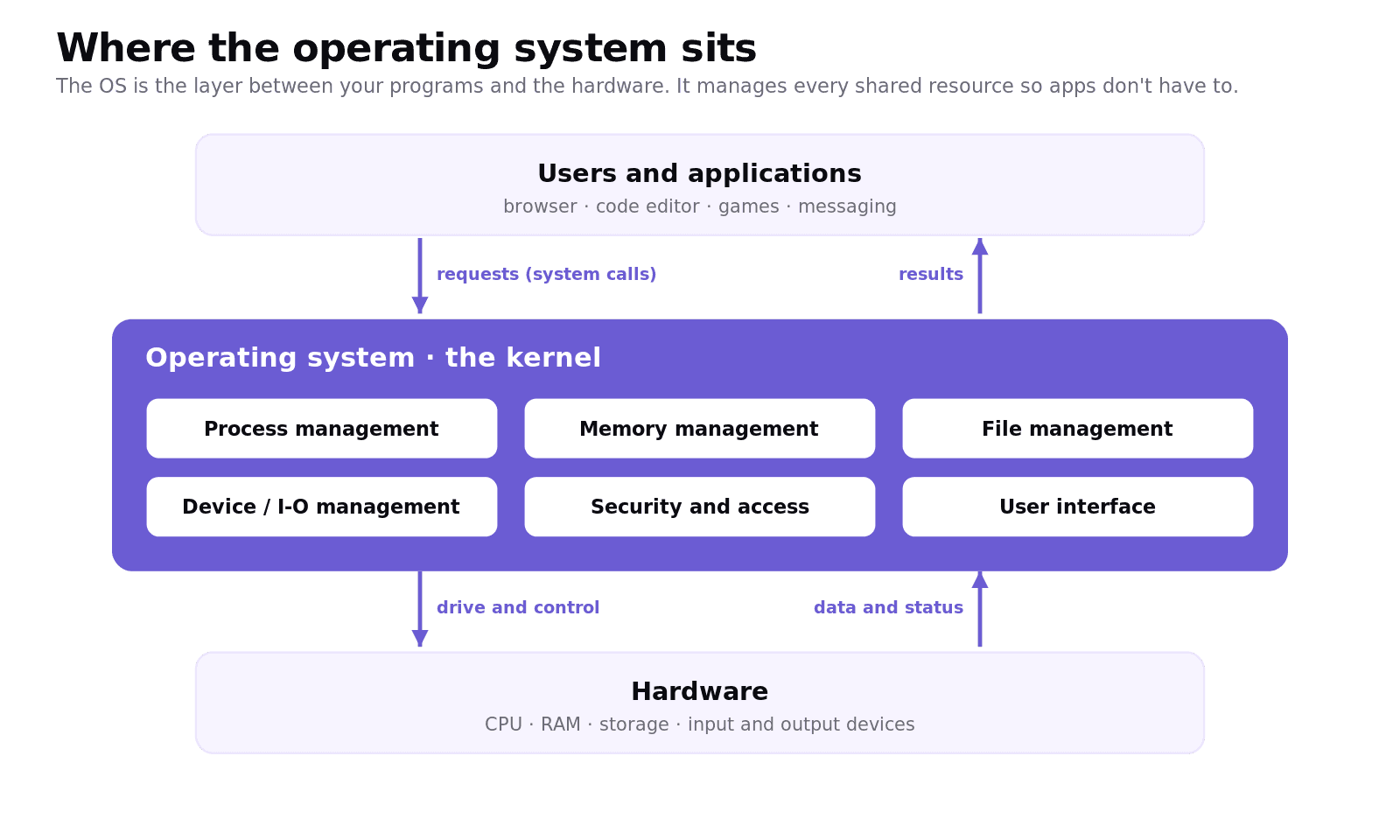
An operating system (OS) is the software layer between the user's applications and the hardware. When a program wants to open a file, draw to the screen, or send data over the network, it asks the OS rather than touching the hardware directly.
That layer matters because the hardware is shared. Dozens of programs want the CPU, memory, and disk at once, and the OS arbitrates fairly and safely so that one app cannot freeze the machine or read another app's data. Familiar examples include Windows, macOS, Linux, Android, and iOS.
What are the main functions of an operating system?
The IB groups the OS's work into a handful of management functions.
Process management schedules processes onto the CPU and tracks each one's state. Memory management allocates and frees RAM, keeps processes in separate spaces, and (on capable systems) provides virtual memory. File management organises files and folders and controls who may read or write them. Device management uses drivers so the OS can talk to keyboards, printers, and disks. Security and access handles authentication, permissions, and audit logging. The user interface, whether a desktop or a command line, is how a person drives all of the above.
What are the different CPU scheduling algorithms?
Only one process runs on a core at a time, so the OS must decide who goes next. Scheduling is judged on metrics such as throughput, turnaround time, and waiting time.
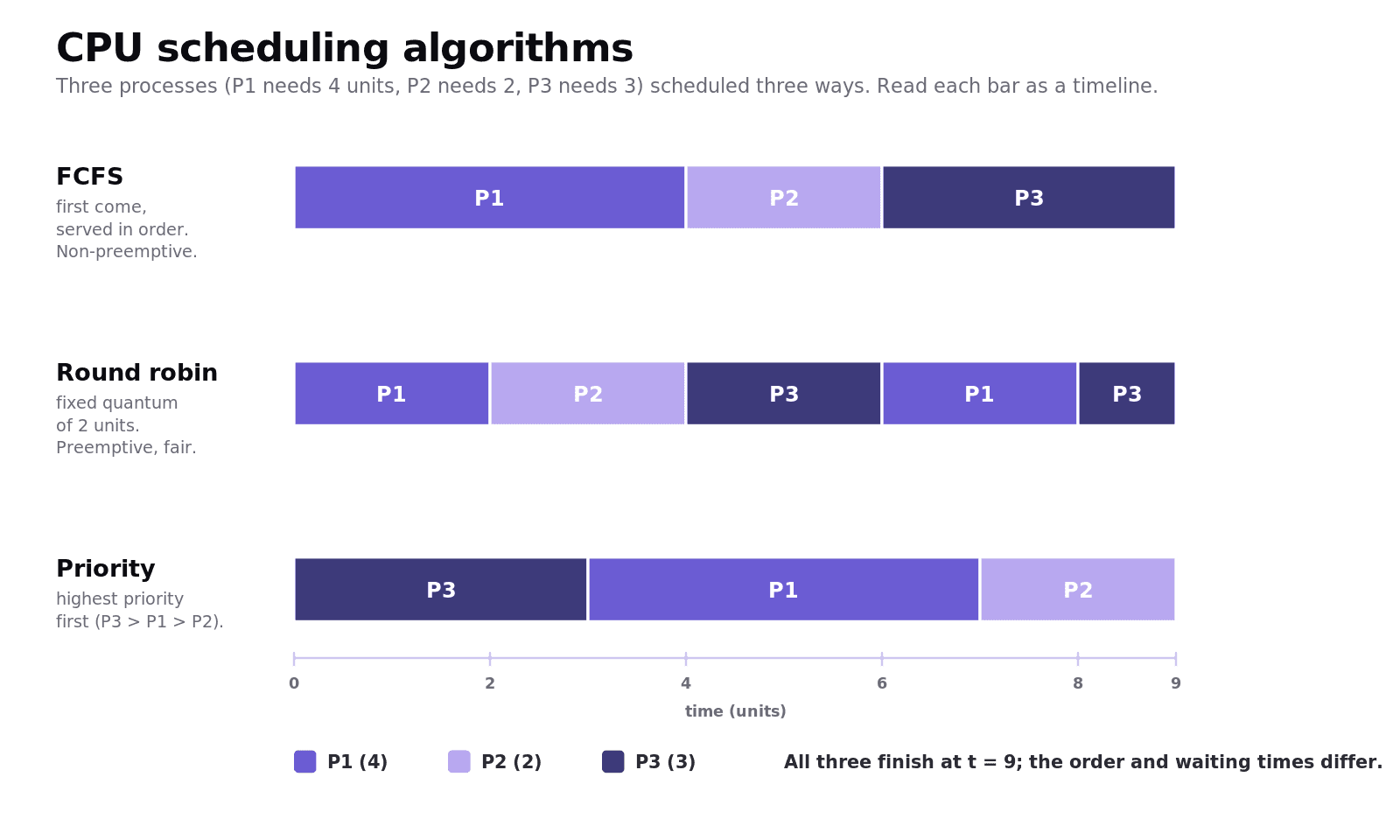
First come, first served (FCFS) runs processes in arrival order and never interrupts a running one, which makes it simple but lets a long job block everyone behind it. Round robin gives each process a fixed time slice, the quantum, and rotates through the ready queue, which keeps the system responsive and fair. Priority scheduling runs the highest-priority process first, which can starve low-priority jobs unless priorities are adjusted over time. The syllabus also mentions shortest job first and multilevel queue scheduling.
Schemes that can interrupt a running process, like round robin, are preemptive; schemes that let it finish, like FCFS, are non-preemptive.
Worked example: three processes, three schedulers
Take P1 needing 4 time units, P2 needing 2, and P3 needing 3.
FCFS runs P1 (0 to 4), then P2 (4 to 6), then P3 (6 to 9). P3 waits a long time.
Round robin with a quantum of 2 runs P1, P2, P3, then back to P1 and a final slice of P3. No process waits too long for a turn.
Priority with P3 highest runs P3 (0 to 3), P1 (3 to 7), then P2 (7 to 9).
All three finish at t = 9, but the order and the individual waiting times differ, and that is what the metrics measure.
What is the difference between polling and interrupts?
These are two ways for the CPU to handle devices. With polling, the CPU repeatedly checks each device in a loop to ask whether it needs attention. It is simple, but it wastes cycles checking devices that have nothing to report.
With an interrupt, the device signals the CPU when it needs service. The CPU saves its current state, runs an interrupt service routine (ISR), then restores its state and carries on. Interrupts are efficient for events that are infrequent or unpredictable, such as a key press, while polling can be the better choice when a device is checked very frequently or on a tight, predictable schedule. When you evaluate the two, weigh event frequency, CPU overhead, power use, and how quickly the event must be handled.
How does the OS manage multitasking and resource allocation? (HL only)
Multitasking is the OS running many processes seemingly at once by switching the CPU between them quickly. Each switch is a context switch: the OS saves one process's state and loads the next.
To fit more programs than RAM can hold, the OS uses virtual memory, giving each process its own address space and moving fixed-size pages between RAM and disk in a process called paging. Because processes compete for the CPU, memory, and files, the OS must avoid resource contention and the worst case, deadlock, where processes each hold a resource the others need and none can proceed. This whole understanding, A1.3.5, is HL only.
What are the components of a control system?
A control system manages a physical process using the input, process, output model with feedback.
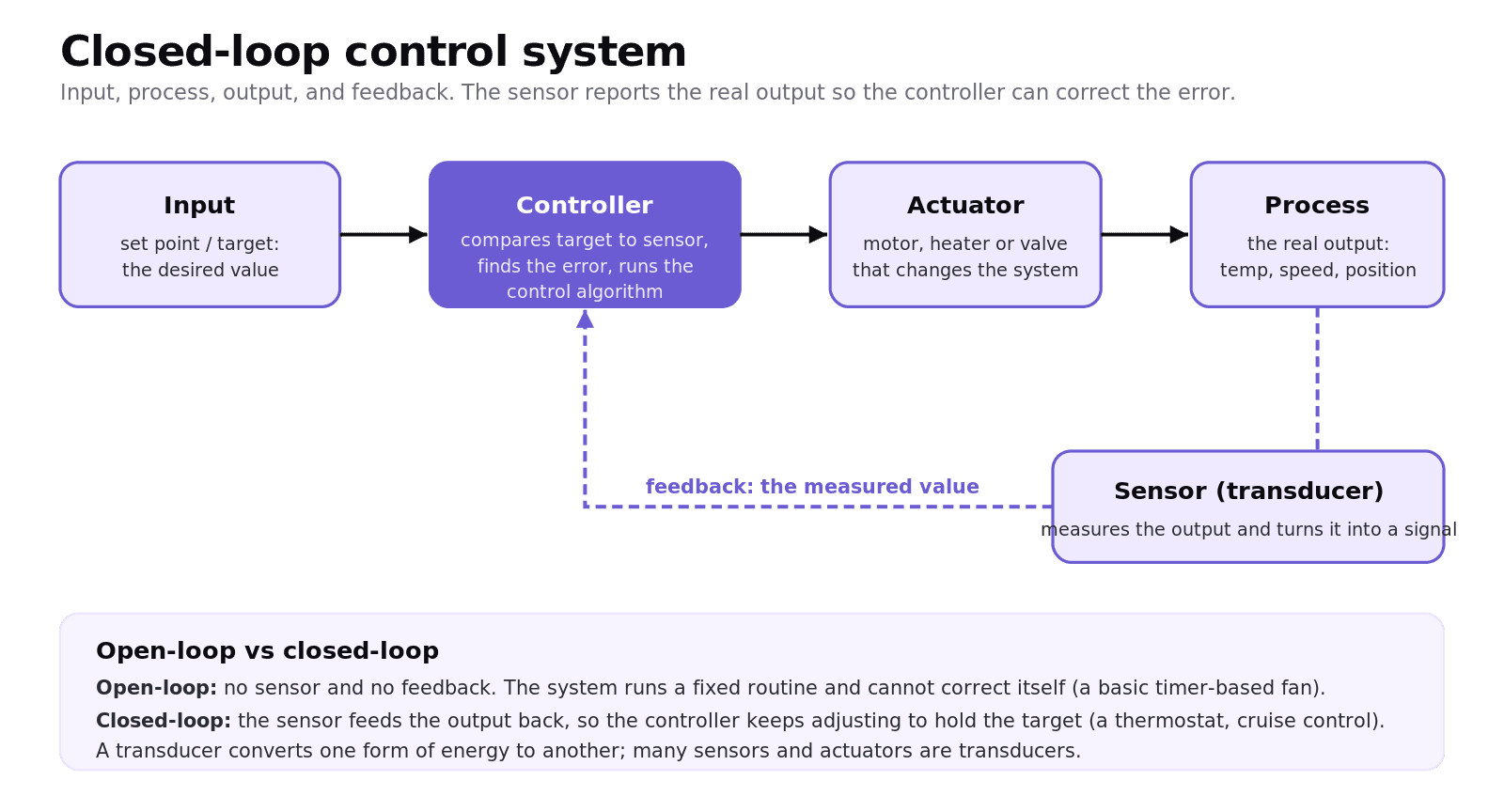
A sensor measures the current state, such as temperature or speed, and a transducer converts one form of energy into another (many sensors and actuators are transducers). The controller, usually a microcontroller, compares the measured value to the target, calculates the error, and runs a control algorithm. An actuator, such as a motor, heater, or valve, then changes the system.
The key distinction is the loop. An open-loop system has no feedback and runs a fixed routine regardless of the result, like a fan on a timer. A closed-loop system feeds the sensor reading back so the controller can keep correcting toward the target, like a thermostat.
Where are control systems used in the real world?
Home thermostats are the classic closed-loop example: a temperature sensor reports to a controller that switches the heating on or off to hold a set point. Autonomous vehicles are far more complex but follow the same model, fusing data from LIDAR, radar, cameras, and ultrasonic sensors, running path-planning and obstacle-avoidance algorithms, and driving actuators for steering, throttle, and braking. Building management systems scale the thermostat idea across a whole building, balancing comfort against energy cost.
Common exam mistakes for IB CS A1.3
Treating the OS as just the user interface. The UI is one function among process, memory, file, device, and security management.
Claiming interrupts are always better than polling. Polling can win for frequent or predictable events; interrupts add overhead per event.
Confusing preemptive and non-preemptive scheduling, or calling round robin the "fastest" rather than the fairest.
Mixing up a sensor (measures input) with an actuator (changes output).
Confusing open-loop (no feedback) with closed-loop (uses feedback to self-correct).
Forgetting that multitasking and resource allocation (A1.3.5) is HL only.
Quick recap of A1.3
The operating system sits between applications and hardware and shares resources safely.
Its functions are process, memory, file, and device management, plus security and the user interface.
Scheduling algorithms (FCFS, round robin, priority) trade simplicity, fairness, and responsiveness.
Polling loops to check devices; interrupts let devices signal the CPU and run an ISR.
HL only: multitasking uses context switching, virtual memory, and paging, and must avoid deadlock.
A control system uses sensors, a controller, and actuators, and a closed-loop design adds feedback.
Frequently asked questions
What is the main role of an operating system?
An operating system is the software layer between applications and the hardware. It manages and shares the CPU, memory, storage, and devices so that programs can run safely and fairly without controlling the hardware directly.
What is the difference between polling and interrupts?
With polling, the CPU repeatedly checks each device to see whether it needs attention, which is simple but wastes cycles. With an interrupt, the device signals the CPU, which pauses, runs an interrupt service routine, then resumes, making it more efficient for infrequent or unpredictable events.
What is the difference between preemptive and non-preemptive scheduling?
Preemptive scheduling can interrupt a running process to give the CPU to another, as round robin does with its time quantum. Non-preemptive scheduling lets a process run until it finishes or blocks, as first come, first served does.
What is the difference between a sensor and an actuator?
A sensor measures a physical quantity, such as temperature or position, and reports it to the controller. An actuator does the opposite, acting on the system to change it, such as a motor, heater, or valve.
What is the difference between open-loop and closed-loop control systems?
An open-loop system runs a fixed sequence with no feedback, so it cannot react to the actual result, like a fan on a timer. A closed-loop system uses a sensor to feed the output back to the controller, which keeps adjusting to hold the target, like a thermostat.
Is multitasking and resource allocation HL only in IB Computer Science?
Yes. Understanding A1.3.5, on the operating system managing multitasking and resource allocation, including context switching, virtual memory, paging, and deadlock, is part of the HL-only content in A1.3.
Looking for a printable summary? Grab the A1.3 Shuttle Learning revision sheet, a three-page knowledge organiser covering everything above.
Looking for an IB Computer Science tutor?
Hi, I'm Yuness, the tutor behind Shuttle Learning. I work one to one with IB Computer Science students at SL and HL, and I deliberately take on only a handful each year so every student gets my full attention. Most go on to earn the 6s and 7s they were aiming for, in the final exams and the IA alike.
If you would like that kind of support, book a free 15-minute call and tell me what you are stuck on. You can press BOOK A LESSON .